Championship Leadership: How to Measure and Define It
Leadership is often what separates two evenly matched teams — and it's the one cornerstone bar you can't read off a box score. A 12-point rubric for scoring it: the Five Cs, a first board of the league's leaders, and the number that explains Kevin Durant's entire career.
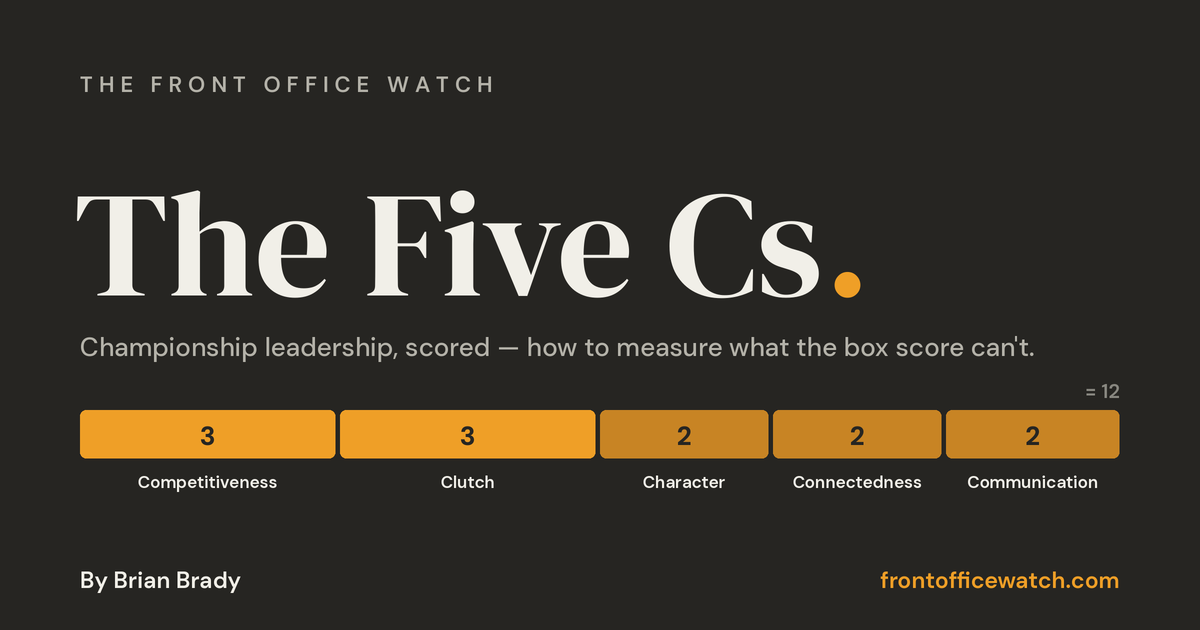
By Brian Brady. The cornerstone test's leadership bar is the one that collapses into vibes without a rubric. This is the rubric.
I love the NBA for a lot of reasons — the athleticism, the strategy, the tension and flow of a great, competitive game — but one aspect I find particularly captivating is the leadership (or lack thereof) of the key players and coaches in a contest. When two closely matched teams meet, the leadership factor is often the difference between winning and losing.
It's hard to quantify leadership for two reasons: everyone's definition is a little different, and it's very difficult to measure what is often a subjective observation. But just because it's challenging does not mean we shouldn't do it. Establishing a solid measurement system for sports leadership could fundamentally reshape franchise construction — and dictate the path to a title. It's also why the framework's cornerstone test needs this bar to be scored, not felt: of the five bars — contracted, available, prime years, proven engine, established leader — the leadership bar is the only one that can't be settled by a contract database or a box score.
The Five Cs of Championship Leadership
Having grown up watching Michael Jordan win six championships, I'm influenced by his style of leadership. But Kobe Bryant (5 rings), Tim Duncan (5), Steph Curry (4), LeBron James (4), Dwyane Wade (3) and others also shape my thinking — as does a couple of decades working in youth civic leadership development. Mostly, though, I'm inspired to write this because I'm not sure I have ever seen a better leader than Jalen Brunson. He's not in the same league, athleticism-wise, as any of the stars above, but he has maxed out his athletic potential and merged it with perfect championship leadership.
Here are my five categories of Championship Leadership (trademark pending), scored on a 12-point scale. Think Spinal Tap's amp that goes to 11 — this one goes one better.
Competitiveness (3 pts). Sometimes best judged by how much a player wants to win meaningless games — see Jordan's coin-toss contest with his security guard in The Last Dance.
Clutch (3 pts). Not just about making shots. It's about missing them, and coming back the next night to take the same shot without hesitation.
Character (2 pts). You don't need the morals of the Pope, but you do need a code for how you approach your work and the people around you that is consistent and purposeful. The support system and family around a player is often the best indicator.
Connectedness (2 pts). The EQ part of leadership. The great leader inspires togetherness and chemistry — not always by being Mr. Friendly, but by valuing the off-court connections that support on-court chemistry.
Communication (2 pts). The IQ part of leadership. Championship leaders can communicate their thinking and goals to different people at different times — and those skills, along with character, are what survive the media glare, the pressure, and the strange life of public celebrity.
The tiers
- 10–12: A leader you build on. The franchise can be his.
- 8–9: Needs leadership covered elsewhere. Can absolutely win — in tandem. A window piece, not a foundation.
- 7 and below: A structural liability as postseason pressure compounds.
Scoring the league (a first board)
| Player | Compete | Clutch | Character | Connect | Comm | Total |
|---|---|---|---|---|---|---|
| Jalen Brunson | 3 | 3 | 2 | 2 | 2 | 12 |
| Shai Gilgeous-Alexander | 3 | 3 | 2 | 2 | 2 | 12 |
| Nikola Jokić | 3 | 3 | 2 | 2 | 1 | 11 |
| Giannis Antetokounmpo | 3 | 3 | 2 | 1 | 1 | 10 |
| Karl-Anthony Towns | 2 | 2 | 2 | 2 | 2 | 10 |
| Draymond Green | 3 | 3 | 1 | 1 | 2 | 10 |
| Donovan Mitchell | 2 | 3 | 2 | 1 | 1 | 9 |
| Luka Dončić | 3 | 3 | 1 | 1 | 1 | 9 |
| Kevin Durant | 2 | 3 | 1 | 1 | 1 | 9 |
| James Harden | 2 | 2 | 1 | 1 | 1 | 7 |
If you play a team with roughly equal talent and coaching, the leadership of your cornerstone players is a key determinant of whether you win or lose. If your leader is below a 9 on this scale (see Harden), your team will likely flame out as postseason pressure builds. If your top players are a 10 or better, it can help your team leapfrog more talented ones.
A few scores that need their work shown. Green over Durant will surprise people — punching a teammate surely doesn't merit a high connectedness score — but Green is one of the most competitive, clutch, and intelligent basketball players in the NBA. His character and connectedness scores get dinged; he is exemplary everywhere else. Interestingly, I'd have scored Karl-Anthony Towns at a 7 or 8 for most of his career, but his leadership now reads like a 10. The Brunson effect? Maybe. Leadership is not a fixed score, but it's hard to completely transform into an elite leader mid-career. Kevin Durant is the proof: a slightly subpar leader his whole career — the 8-to-9 range — despite elite clutch shot-making. It is not an accident that he could only win a championship in tandem with Steph Curry and Draymond Green.
Can coaches foster leadership? Yes, to a point. I'd argue this was Phil Jackson's greatest contribution to Kobe's and Michael's careers — both were mediocre leaders (maybe 9s) who became very good ones over time. Brunson, though, like SGA, is the full package, without a weakness in his leadership style on or off the court. Curry is probably a 12 as well — and so is SGA, although I might score him lower after this postseason; his body language around teammates felt a bit off this year. (Body-language doctor Bill Simmons, I need a consultation.)
Why this bar exists
With the NBA draft coming up and teams looking for cornerstone players to lead their franchises to a championship level, they need to look under the hood and judge whether each talented player has what it takes to truly lead a team there. The framework's claim, stated plainly: a player who clears the other four bars but not this one wins you a window — in tandem, with the temperature set elsewhere. A player who clears all five buys you run after run. The history of the league's sustained winners is the history of the second kind.
Front Office Watch grades front-office decisions against the team-building phase the franchise is actually in — before the results arrive, on the record. The methodology is public. Argue with the framework, not the outcome.