Reframe: ESPN's Ten Giannis Suitors
ESPN ranked ten Giannis suitors by what they can offer Milwaukee. Nobody asked the only question that prices a 31-year-old cornerstone — is your window open the day he lands? Ten suitors. Two licenses.
Reframe is a recurring series that takes the smartest NBA analysis being made and runs it through the framework — supplying the missing strategic context that turns sharp observations into defensible claims. One question reframes everything: what changes when you establish the team-building phase before grading the moves?
New here? The framework in 60 seconds. Every NBA franchise occupies one of four team-building phases at any moment: Reset (no confirmed cornerstone — accumulate assets, find one), Assemble (a cornerstone identified, confirmed or still a candidate — build a starting five that can actually compete), Calibrate (contender with one diagnosable structural problem — fix it surgically), or Sustain (it works — don't break it). The diagnosis hinges on the cornerstone: a player who clears five bars — contracted, available, sufficient prime years, proven as the primary engine of a winning team against elite competition, and established as the organizational leader, the player the team takes its temperature from. The same trade, contract, or draft pick can be correct in one phase and malpractice in another — which is why grading moves without first diagnosing the phase isn't analysis. It's a box score with extra steps. Read the full framework →
ESPN — What 10 Giannis trade contenders can offer the Bucks
Bobby Marks · May 14, 2026 · the salary tables behind the market for a two-time MVP
Where the ten suitors actually sit on the phase map
A fun what-if — until you notice that eight of the ten trades, executed, would be malpractice.
Go read the full piece — the salary tables, apron mechanics, and pick inventories are the best public accounting of this market anywhere, and nothing below works without them.
Credit where it's due
This is the genre at its best. Bobby Marks has built the definitive mechanical map of the Giannis market: which picks each suitor can legally move and when, where every apron line sits, which player options gate which trades, and the single most underpriced fact in the saga — that a new team cannot extend Antetokounmpo until six months after a trade, meaning every bidder is offering, in Marks' words, "a hefty collection of assets with no guarantee on an extension." The Shams Charania reporting underneath it is why the league knows Milwaukee is open for business at all. If you want to know how each of these ten trades could mechanically happen, nobody does this work better.
What the piece never asks is whether each of these ten trades should happen — and the organizing principle it uses instead, "ranging from lottery teams to title contenders," is the standings. The standings are the box score's idea of a phase. That's the gap this series exists for, because here's what the phase question reveals: this is a fun what-if exercise right up until you notice that if eight of these ten teams actually traded for Giannis, it would be GM malpractice — eight different mistakes, but malpractice all the same.
The phase reasoning the piece does without the vocabulary
Four moments here are doing framework work without naming it.
The Haslam fork. "If Giannis does play somewhere else, we've got to have a lot of assets... and if he's here, then you build the team differently." Milwaukee's co-owner described two different team-building phases in a single sentence — asset accumulation on one branch, win-now construction on the other — without a vocabulary for either. Wes Edens made the fork explicit: "Either he will be extended or he'll be traded." The piece treats these as ownership color. They are the entire strategic question, stated by the people who will answer it.
The Toronto self-audit. The Raptors section invokes the exact precedent this framework runs on — the 2018 Kawhi Leonard trade — and then, to its enormous credit, rejects the parallel: "this Raptors roster is not constructed to win a title, even if Antetokounmpo is paired with Barnes." That is a phase diagnosis. It just doesn't know its own name.
The Stevens diagnostic. Boston's section opens with the president of basketball operations naming a specific structural problem — 27th in paint scoring, "I think we need to add to our team to do that" — and immediately notes that no player on Earth scores more paint points than Antetokounmpo. A named structural problem and the league's most precise solution to it: that is Calibrate logic, fully assembled, waiting for someone to say the word.
The recurring question nobody answers. Golden State: "what would be left of the roster?" Minnesota: "what would be left of the Wolves' roster?" New York: "would need to part ways with half its starting lineup." The piece keeps arriving at the same question — what does this team become after the trade? — and treats it as a caveat each time. Asked once, it's a caveat. Asked three times, it's the methodology trying to surface.
What is a 31-year-old cornerstone?
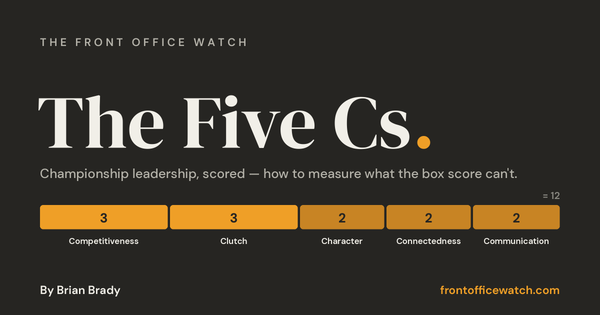
Start with the product, because the framework's Giannis doctrine has been on the record since this series' first installment, on Houston's summer: at 31, Antetokounmpo is not one product — he is a different product in every phase. Run the bars. Contracted: two years, the second a player option, with the extension gap Marks documents. Available: 36 games this season — an open question, not a closed one. Proven as the engine: permanently, a championship's worth. And the leadership bar, the one that ruled Durant out of the cornerstone role in Houston: Giannis scores a 10 on the Five Cs — the leader-you-build-on tier. That bar is what makes this categorically different from the Durant trade this series graded last time: a team acquiring Giannis is buying a whole cornerstone, not a share of one. What it's buying less of is time.
And his time is the one term nobody can negotiate. His elite years are front-loaded — the value is year one and year two, with steep uncertainty after, and an injury-shortened season just behind him. Which produces the principle that sorts this entire market:
A 31-year-old cornerstone is not a foundation. He is a completion. You cannot build toward him — you can only finish with him.
So the license to bid reduces to one test, applied from the acquirer's standpoint: could this roster, plus Giannis, contend in October — with the players you keep? If the honest answer contains the phrase "and then we'd add..." — you are not licensed. The phases are how you find the candidates. The test is the gate. And the extension risk Marks flags prices differently on each side of it: for a team whose window opens the day Giannis lands, no-guarantee is the Kawhi rental — Toronto accepted exactly that risk in 2018, eyes open, and hung a banner, because the payoff was collectible inside the rental window. For everyone else, no-guarantee on a 31-year-old is the whole bet with no floor under it. Same risk, opposite verdicts. The phase is the pricing model.
Ten suitors. Run the test. Two licenses.
The two licenses
Boston is the cleanest license on the board — the closest thing to Toronto 2018 since the original. Confirmed cornerstone: Jayson Tatum, who returned from the Achilles in March, picked up another knock late in the year, and is expected to be ready when next season opens. A championship-grade structure around him. A structural problem named by the president himself — 27th in paint scoring — that Giannis solves more precisely than any player alive. Even the package matches the precedent's shape: Brown-for-Giannis is the DeRozan-for-Kawhi silhouette — your established star out, the superstar in, the extension risk accepted as the rental price a banner already justified once. And Boston's version is actually safer than the original: Toronto sent out its best player and bet everything on the rental; Boston would keep its cornerstone and rent the second star. Marks says "hard no" on extension-risk grounds, and it's the one place the framework respectfully disagrees: that answer overvalues certainty and undervalues the precedent. The discipline Boston owes is on price, not phase — a two-year window licenses the co-star and change; it does not license the decade.
Cleveland is the license that requires a needle. Credit where due: the Harden renegotiation route Marks maps through the second apron is genuine front-office craft. The framework adds the reason the contortion might be worth it — run Cleveland's room through the leadership rubric and the top of the roster scores in the covered-leadership tier; the playoff ceiling this franchise keeps hitting may live on exactly that bar, and Giannis is a 10. That makes Cleveland the suitor whose specific structural problem Giannis most precisely fixes. The price is the problem: thin on tradeable firsts, which makes Evan Mobley the package, which trades the frontcourt's future for its present, threaded through an apron the team currently sits above. Licensed — and expensive in the exact currency Cleveland can least recover.
The disciplined declines
Here is where the framework grades its own map, because two more teams sit in Calibrate — the licensed phase — and the framework tells both to put the phone down.
Houston was graded before this market opened, in this series, on the record: a second maximum-priced fix before the first fix's evidence exists is doubling the bet blind. Rafael Stone's quote in Marks' piece is the run-it-back verdict in the GM's own voice — "continuity will help us" — and he's right. The condition Marks attaches ("only if Thompson is not included") protects the candidate but not the sequence. Houston declared Calibrate when it traded for Durant, then injuries cancelled the experiment before it ran — so the verdict on the record is: run the healthy season first, and make the stay-or-fold decision at the 2027 trade deadline, when Houston's assets regain full market value. Adding Giannis now would be paying a second maximum price before the first one has produced a single data point.
Denver fails the license's second condition: Calibrate isn't a phase you bid from, it's a phase you diagnose from, and Denver's diagnosis isn't done — a new GM, a new coach, and a structural problem that hasn't been named yet and might be sitting on the bench rather than the roster. Calibrate fixes are ordered by invasiveness: a coach, a contract, a trade, a superstar trade. Giannis is the most invasive, most expensive surgical fix in league history, and you do not order that surgery before the X-rays are back. Note who agrees: Denver isn't even in ESPN's ten. The market ran the test already.
The skip tier — legal, and vacant
Can an Assemble team buy its way past the rest of the build? The framework's doctrine, from the Rockets piece: phases are a map, not a conveyor belt — teams can buy their way across, and the only question is whether the diagnosis underneath the jump is sound. The skip is legal. This year, nobody clears the gate.
Minnesota has the confirmed cornerstone and the deadline pursuit to prove intent, and the apron math answers the year-one test for them: two tradeable firsts means the package is McDaniels plus Randle or Reid — the depth that makes Minnesota itself — with the roster backfilled on minimums. Pairing two engines by gutting the supporting cast manufactures the structural problem it claims to solve. Marks' own question — "what would be left of the Wolves' roster?" — is the verdict.
Toronto already wrote its own. The 2018 trade was legitimate because Toronto was Calibrate — a 59-win contender with one problem — not because Toronto is Toronto. The precedent is a phase condition, not a franchise heirloom, and the piece's honesty about it ("not constructed to win a title, even paired with Barnes") plus Bobby Webster's own caution ("the next steps are going to be even harder") is exactly the discipline mid-Assemble demands.
The Lakers are the romance with the asset problem. The leadership rubric makes the romance real: Giannis's 10 covers the precise bar that Dončić's score leaves open — on paper, a complete cornerstone structure split across two superstars. But Marks' inventory is decisive — no young controllable contracts beyond Knecht, far-dated picks Milwaukee shouldn't covet — and the phase-rational version is the one his piece names itself: hold the 2027 cap space, let Antetokounmpo play hardball, sign him outright next summer. For once, patience is the aggressive move.
The failed exception
Miami is the one Reset team with a sanctioned path, and the sanction is the problem. The Phase Report said it two weeks ago: trading for a proven primary engine is the only Path 2 worth executing — without compromising the development infrastructure. Now look at the reported deadline framework: Herro, Kel'el Ware, picks and swaps. Ware is the infrastructure. The price of the engine is the structure the engine was supposed to complete, which means Miami fails the year-one test the moment it pays the toll. What's left is the oldest habit in the building: big-game hunting. Pat Riley's last bagged kill was Jimmy Butler in 2019; the hunts since — Lillard, Durant — came home empty, and this would be the wrong moment to finally pull the trigger: a 31-year-old engine bolted to a roster that just paid its supporting cast to acquire him. The version that passes the published condition is the one Marks himself identifies — 2027 cap space, sign him outright, keep everything. Miami's licensed move is to wait.
The forbidden tier
New York is the easiest verdict on the board, and the calendar makes it poetic: Marks wrote in May asking whether a Finals berth "would put a freeze on Antetokounmpo trade talks." The berth arrived — the Knicks are playing in the Finals as this publishes. Sustain's entire discipline is refusing the unnecessary trade, and the piece's own accounting — Anunoby, Bridges, Hart, "half its starting lineup" — describes dismantling a roster in the middle of validating itself at the sport's highest level. The genre's favorite wrinkle, Antetokounmpo's reported only-New-York preference, just makes the most willing destination the least licensed buyer. Bob Myers built a dynasty on the trades he didn't make. Leon Rose's version of that discipline is this exact non-decision.
Golden State is the framework's standing misdiagnosis case — Reset, performing Calibrate, the verdict published in the foundational essay. Marks quotes Mike Dunleavy Jr.: "as long as we're in this win-now window." The window is the thing that no longer exists. Four tradeable firsts plus Draymond Green — mandatory salary in any deal, per the piece's own math — for a 31-year-old beside a 38-year-old Curry converts the next era's entire seed stock into roughly two years of maybe.
Portland was diagnosed in the Phase Report days before this market matured — candidate unanchored, a front office hedging in every direction, with the Giannis interest cited as evidence in advance. The mechanics are worse than the diagnosis: the cleanest asset Portland would surrender is Milwaukee's own draft future, handed back for an unextended 31-year-old, plus Jerami Grant's contract absorbed for the privilege, in service of a Lillard reunion that Marks prices honestly at "potentially just one season." A Reset team paying cornerstone prices for a window it has no contender to attach to. Textbook.
What the tepid market is actually telling you
Count the licenses: two, on a ten-team list. League reporting says the market has come back far more tepid than expected, and the coverage treats that as a surprise about asset valuations. It isn't. A 31-year-old at supermax prices with no extension guarantee is phase-coherent for a band of teams that is narrow by construction — and look at who isn't on Marks' list at all: Oklahoma City, San Antonio, Detroit. The Sustain teams and the disciplined builders self-selected out before the exercise began. The market already runs the year-one test. The analysis around it doesn't.
The seller's clock — a different scorecard
None of the above is Milwaukee's problem. The buyer's license prices the buyer's decision; the seller's job is Reset, and Reset teams are supposed to be the counterparty to other franchises' mistakes. Every misdiagnosis on this list is Milwaukee's payday — the framework can grade a bid as malpractice and grade Jon Horst highly for harvesting it, on the same trade, at the same time.
So rank the actual packages by the only metric Milwaukee's phase cares about — the best chance at finding the next cornerstone — and the market inverts beautifully. The licensed buyers pay in the wrong currency: Boston's offer is a 29-year-old co-star on $57 million and a contender's late firsts; Cleveland's is an elite co-star who is not an engine, plus scarce picks. Reset can't use either. The unlicensed buyers pay in exactly the right one. Golden State's hypothetical package — the 11th pick in a draft whose cornerstone tier the Phase Report already mapped, plus firsts in 2028, 2030 and 2032 with seven years of swaps, from a roster whose three top salaries are all on the wrong side of 35 — is far-dated, unprotected exposure to a collapsing era. That is the asset profile that built Oklahoma City. Portland's package — Milwaukee's own swaps returned, un-capping the Bucks' own rebuild, plus an unprotected 2028 Orlando first and young candidates — is the second-best Reset haul on the board, with Grant's contract as an absorbable toll. The teams that should call can't pay Milwaukee right. The teams that can pay right are the ones that shouldn't call. Horst's job is to not care.
And the clock is real. The piece's own State of the Bucks section is the keep-path refutation, written in cap math: over the cap, nine free agents, $20.2 million a year of Lillard dead money through 2029-30, and a $15.1 million midlevel as the headline tool. "Build the team differently if he's here" means performing Calibrate with a midlevel exception — that isn't a phase, it's a pose with a payroll. Trough value today is worth more than floor value in two years, and the best version of the return — picks that convey in this draft, into a mapped lottery class — exists on exactly one date. Haslam said it himself: before the draft, "we've got to have a lot of assets."
The Verdict Ledger
On the record, June 2026. Check back June 23.
Milwaukee: trade him before the draft, to whichever buyer maximizes cornerstone-search currency — draft access now, far-dated exposure to declining rosters, young candidates — regardless of whether the buyer is making a mistake. The tripwire is dated: if draft night passes with Antetokounmpo neither extended nor traded, Milwaukee has chosen the worst branch — the option decayed, the fork unchosen, the assets aging in place.
The licensed bids: Boston's, the Toronto 2018 shape reproduced more faithfully than any trade since the original — with the discipline owed on price, not phase. Cleveland's, only if the apron needle threads at a cost the franchise can survive.
The malpractice charges, pre-filed: Golden State and Portland — Reset teams paying cornerstone prices for windows attached to nothing — and New York, if a team playing in the Finals somehow talks itself into breaking what it just built. Houston and Denver: not malpractice, just premature — the framework's own Calibrate teams, told to finish their diagnoses first.
We'll grade every one of these against this page when the dominoes fall.
The Front Office Watch grades front-office decisions against the team-building phase the franchise is actually in — before the results arrive, on the record. The methodology is public. Argue with the framework, not the outcome.
Next Reframe: Third Apron's two-part Mavericks offseason — "Building Around Cooper Flagg" is a phase declaration in a podcast title, and we're going to test it.