Game Theory's Rockets Preview
A sharp 50-minute Rockets preview — and the question that should have opened it arrives at minute 31, buried inside a Giannis hypothetical.
Reframe is a recurring series that takes the smartest NBA analysis being made and runs it through the framework — supplying the missing strategic context that turns sharp observations into defensible claims. One question reframes everything: what changes when you establish the team-building phase before grading the moves?
New here? The framework in 60 seconds. Every NBA franchise occupies one of four team-building phases at any moment: Reset (no confirmed cornerstone — accumulate assets, find one), Assemble (a cornerstone identified, confirmed or still a candidate — build a starting five that can actually compete), Calibrate (contender with one diagnosable structural problem — fix it surgically), or Sustain (it works — don't break it). The diagnosis hinges on the cornerstone: a player who clears five bars — contracted, available, sufficient prime years, proven as the primary engine of a winning team against elite competition, and established as the organizational leader, the player the team takes its temperature from. The same trade, contract, or draft pick can be correct in one phase and malpractice in another — which is why grading moves without first diagnosing the phase isn't analysis. It's a box score with extra steps. Read the full framework →
Game Theory Podcast — Rockets offseason preview
Vecenie & Simon · 50 minutes of Houston's summer
Watch the episode → · Substack
Fifty minutes on how Houston could spend. Zero on which summer Houston should be having.
Go listen to the full episode — this piece is about what the genre skips, not what these two get wrong, and their offseason preview series is among the best in the format.
Credit where it's due
This is a good episode. Vecenie and Simon are two of the sharpest roster-mechanics analysts working — the Amen Thompson extension discussion is grounded in real evidence (3,000 minutes, 79 games, the 76% finishing at the rim, the Şengün contract comp), the apron math is precise, and the Eason restricted-free-agency calculus is exactly the kind of granular work most coverage skips. If you want to understand how Houston's summer could mechanically unfold, this is the episode.
What it never establishes is which summer Houston should be having. That's not a knock unique to this show — it's the genre. Which is the point of this series.
The phase reasoning they did without the vocabulary
Three moments in this episode are doing framework work without naming it — and a fourth is holding the key to the whole conversation without realizing it.
Minute 31 — the buried lede. Deep into the Giannis hypothetical, Vecenie asks: "Do you think that any window currently exists with their core?" Simon answers: "No... I'm not convinced that an actual window exists" against OKC and San Antonio. That is a phase-diagnosis question — arguably the phase-diagnosis question for this roster — and it arrives at minute 31, as a debate tactic inside a trade hypothetical, rather than at minute one as the premise of the episode. Everything before it was analysis conducted without a diagnosis.
The Şengün case. Vecenie's argument for trading Alperen Şengün — "worse than the sum of his parts," a "developmental hinderer" for Jabari Smith, Reed Sheppard, and especially Amen Thompson — is an unstructured cornerstone evaluation. He's arguing Şengün is neither a cornerstone nor a compatible co-star. That's a framework claim. Made explicit, it forces the next question: then who is the cornerstone here? The episode never asks.
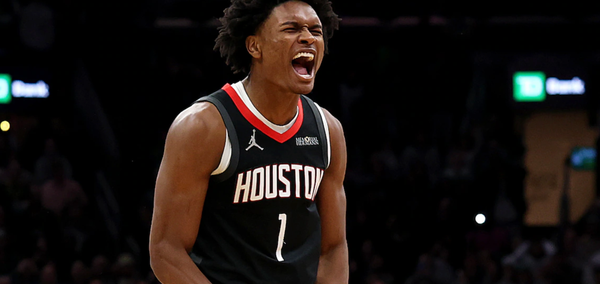
"I'm willing to go down with the ship with Amen Thompson." This is a cornerstone declaration — made on minutes played, work ethic, and defensive impact. All real evidence. But run Thompson through the diagnostic: contracted (pending this extension), available (emphatically — 79 games, 37 minutes a night), sufficient prime years (yes). The fourth and fifth bars — proven as the engine, established as the leader — are both open. Kevin Durant holds the engine role. Fred VanVleet holds the locker room. Thompson is a cornerstone candidate, and the difference between candidate and confirmed is the difference between a $40M bet and a $40M certainty. The episode prices him as the latter while describing the former.
"That is a real addition for them." The episode's second minute, on Fred VanVleet's return from injury. This is the evidence-quality observation that should govern everything that follows — Houston's season, including the high-leverage offensive collapse and the playoff exit, happened without the starting point guard and without Steven Adams. The hosts state the fact, credit its importance, and then spend 48 minutes evaluating the roster as though the injured season were a clean read on it. Holding the key and never turning it.
Now run the framework
Ask the phase question first and the episode reorganizes itself.
Houston's diagnosis is genuinely contested — which is exactly why it should be argued openly instead of assumed silently. Strip out Kevin Durant and the roster reads Assemble-Candidate: building around Thompson before he's confirmed. But you can't strip out Durant, because acquiring him was itself a phase declaration. Trading real assets for a 37-year-old is Calibrate behavior, definitionally — it only makes sense if the front office believes a Finals-caliber window exists within the next year or two. Houston declared Calibrate last summer the moment the trade was signed.
The objection, and the precedent. "You can't trade for your best player at Calibrate — the phases are supposed to go in order." The framework never said that. The phases are a map, not a conveyor belt: teams can buy their way across it, and the framework only asks whether the diagnosis underneath the jump is sound. The precedent is Toronto, 2018 — a Calibrate team trading for cornerstone-caliber talent, and winning the title for it. The move was legitimate because Kawhi Leonard cleared the bars that matter for a window: 27 years old (prime years, pass), a Finals MVP who had carried a champion (proven engine, pass), with the leadership bar covered by Kyle Lowry's locker room. It was also, honestly, nearly catastrophic — lose that Finals and watch Kawhi walk anyway, and Toronto is set back half a decade. The Raptors knew the risk and bought the window with eyes open.
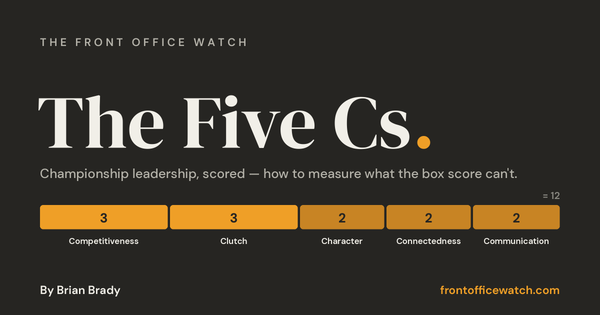
Houston ran the same move shape with the opposite diagnosis underneath. Durant at 37 fails prime years. And the leadership bar — the one that needs a rubric to stay out of vibes — catches what age alone misses: Durant scores a career-long 9 on the Five Cs, elite clutch shot-making wrapped around subpar temperature-setting. The 8-to-9 tier wins championships in tandem — it's not an accident his rings came alongside Steph Curry and Draymond Green — and founds nothing. Which resolves the vocabulary question this trade confuses people with: Durant is not Houston's cornerstone and can't be, because cornerstone is a structural role, not a talent tier. The sharpest way to say what Houston did: it acquired a cornerstone-caliber player who cannot be a cornerstone, and asked him to do a cornerstone's job.
Or rather — asked three people to. Look closely at the roster and Houston didn't acquire a cornerstone; it disaggregated one. VanVleet holds the leadership. Durant holds the engine. (Thompson, the heir apparent to both jobs, holds neither yet.) Championships have been won with the functions split — Durant's own Warriors, Kawhi's Raptors — but split arrangements win windows and then dissolve. A unified five-bar cornerstone — Duncan, Curry, Jokić, SGA — buys you run after run. And distributed structures carry a failure mode no box score shows: lose one share and the whole thing collapses. Houston didn't lose "its starting point guard" last season. It lost the leadership share of its distributed cornerstone — and the structure failed exactly the way the framework predicts when a cornerstone goes missing. The hosts hold this key in the episode's second minute ("that is a real addition") and never turn it.
And the leadership share was thinner than anyone priced. Houston's culture change was built on two veteran voices — VanVleet and Dillon Brooks. The Durant trade sent one of them out the door; the ACL took the other before opening night. The season everyone is now grading ran with neither voice in the room. A confirmed cornerstone makes the leadership question unaskable — nobody wonders whose team OKC is. Houston spent last season unable to answer it at all.
And one more box-score trap, on Şengün. Vecenie's "worse than the sum of his parts" deserves a sharper name, and the framework's own foundational case supplies it: the Vučević trap — high-usage hub production that resembles a cornerstone in a box score without ever being the engine of elite wins. Whether Şengün is that, or something tougher, is one of the specific questions the healthy season answers. The episode argues it by feel; the framework says: run the test before you price the answer.
Untested, not failed. The season broke the experiment before it ran. VanVleet — the organizing guard the hosts themselves credit as the fix for Houston's turnover problem — never played. Steven Adams was lost too. When Simon concludes at minute 31 that no window currently exists with this core, he's rendering a verdict on a team Houston never actually fielded. The framework's standard for Sean Marks applies in mirror image here: Marks ran Reset correctly in Brooklyn and lost the lottery anyway; you don't grade the process by the ping-pong balls. Houston ran a Calibrate declaration and lost its leader for the year. You don't grade the declaration by the injury report.
The bet, priced
The honest objection to running it back isn't "no window exists." It's "sell now": trade Şengün and Durant, get into the top six of a draft that has Darius Acuff in it, and bet that the next cornerstone arrives on a rookie deal — with Thompson recast as the elite co-star beside him. Call that what it is — not a recalibration, a full Reset — and admit it's a real argument, especially with lottery access attached.
The framework's answer is poker, not pride. The fold window was February. At last season's trade deadline, these assets carried close to full value; folding now pays for the bet and declines the data it bought. Reset stays on the board — but as a decaying option: Durant a year older, Şengün's market drifting with every "worse than the sum of his parts" segment, and the Acuff-class draft access expiring on June 24. What Houston pays to run the healthy test is one year of option decay. The framework grades that price as worth paying — the upside branch is a Finals window, and the downside branch still contains a viable Reset — and it prices the next go/no-go where the option re-peaks: the 2027 trade deadline, when these assets command full market value again. That's the fork's real date. Not draft night. Not October.
The Verdict Ledger
On the record, June 2026. Check back at the deadline.
The Thompson extension. Phase-correct in every branch — including Reset, where he becomes the offensive engine of the search itself, which is precisely the laboratory that could confirm him. If Houston signs it in the $38–40M range, the framework grades it as a defensible Assemble-Candidate commitment — and the floor is what makes it safe. The downside of this extension isn't a bust; it's a 24-year-old, hyper-athletic, $40M-a-year elite co-star. Every team in the league takes that and develops him.
Thompson's summer (new). One job: a thousand shots a day, and three spots on the floor he owns and gets to at will. His path to the engine bar is the Jimmy Butler path — playoff force without elite volume shooting — and it's narrow. This is a falsifiable checkpoint: if the jumper doesn't move by the deadline, the candidacy narrows from cornerstone toward elite co-star — the Pippen track. In today's CBA that track costs nearly the same in salary (ask Jaylen Brown's supermax); what changes is everything it licenses around him — a co-star justifies a different build, not a cheaper contract.
The Eason decision. The episode's instinct is right and the framework sharpens it: paying ~$20M to retain Eason while still carrying Finney-Smith's $13.3M is Assemble money spent twice on the same roster slot. Phase-correct behavior is one or the other — and the hosts' preferred sequence (move Finney-Smith with sweeteners, retain Eason near $20M) is the right one. If Houston pays both, that's a discipline failure regardless of how next season goes.
The Durant declaration (retro-grade). Untested, not failed — but the standing costs are now two, and injuries excuse neither. He occupies the exact engine role Thompson needs to test in, so every season of the partnership defers the confirmation evidence. And he scores in the leadership tier that wins in tandem only — meaning the declaration was always dependent on VanVleet's health in a way nobody said out loud. Next season, with the intended roster and the roles named, is the actual test — and we'll grade it as such.
The Giannis hypothetical. The hosts treat Giannis as a fun escalation; the framework treats him as a sequencing error. Trading Şengün, Sheppard, and four-plus firsts for a second maximum-priced fix, before the first fix's evidence exists, is doubling the bet blind. The same logic grades the full-retool argument — deal Şengün and Durant for a new offensive alpha to pair with Thompson — as a third maximum price for a structure with two unconfirmed bars in it. If Houston privately believes the current configuration can't work even healthy, the honest version of that belief is Reset, declared as Reset.
The verdict: run it back — with the roles named. VanVleet is the leader. Durant is the engine. Thompson is the apprentice with one job. Şengün gets the healthy season to answer the Vučević question. The template is the one VanVleet already lived: Lowry setting the temperature, Kawhi supplying the engine, young Siakam growing into the space between, Gasol anchoring — and VanVleet is the literal bridge between that championship and this attempt. With the honest caveat the hosts would rightly demand: the 2019 East was open, and this West has Wembanyama and SGA standing in it. Phase-correct does not mean favored — the framework grades the decision, not the title odds. So the tripwire goes on the record now: healthy roster, defined roles, and if the halfcourt still collapses by the 2027 trade deadline, the honest answer is Reset, executed at full asset value. Restraint is a decision too. Bob Myers built a dynasty partly on the moves he didn't make; Rafael Stone's next eight months will be graded by the same standard.
The Front Office Watch grades front-office decisions against the team-building phase the franchise is actually in — before the results arrive, on the record. The methodology is public. Argue with the framework, not the outcome.
Next Reframe: ESPN ranked ten Giannis suitors by what they can offer Milwaukee. Nobody ranked them by the only question that prices him — what phase is the buyer in? Before June 23, we will.