The Cornerstone Test: Amen Thompson.
Houston is about to price the answer before the answer exists. Three bars cleared, one open — and the open one is the whole case.
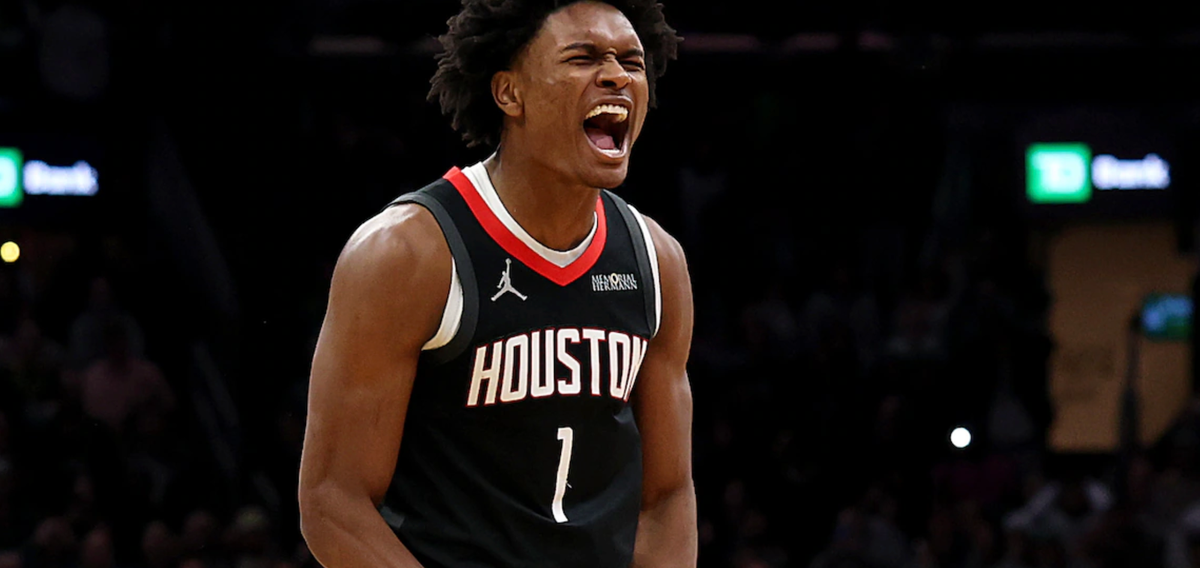
The Cornerstone Test is a recurring series that runs one player through the framework's five-bar diagnostic at the moment his franchise is about to bet on the answer. The test doesn't ask whether a player is good. It asks whether he can carry the weight of being the singular piece a championship organization is constructed around — because the answer determines what his team is licensed to spend.
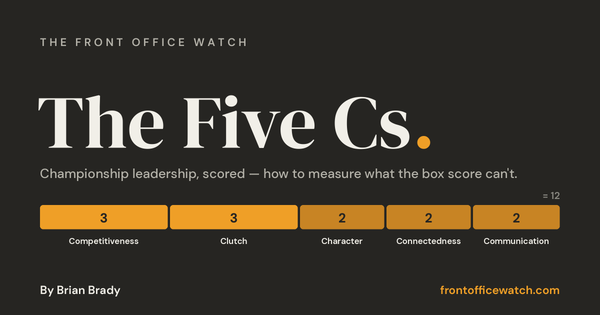
New here? The framework in 60 seconds. Every NBA franchise occupies one of four team-building phases at any moment: Reset (no confirmed cornerstone — accumulate assets, find one), Assemble (a cornerstone identified, confirmed or still a candidate — build a starting five that can actually compete), Calibrate (contender with one diagnosable structural problem — fix it surgically), or Sustain (it works — don't break it). The diagnosis hinges on the cornerstone: a player who clears five bars — contracted, available, sufficient prime years, proven as the primary engine of a winning team against elite competition, and established as the organizational leader, the player the team takes its temperature from. The same trade, contract, or draft pick can be correct in one phase and malpractice in another — which is why grading moves without first diagnosing the phase isn't analysis. It's a box score with extra steps. Read the full framework →
The decision on the clock
Amen Thompson is extension-eligible this summer, and the number being floated around his camp and the analyst class is $38–40 million a year — Alperen Şengün money, roughly, for a 23-year-old who has never been his team's offensive engine. Houston has until the late-October deadline to sign it or let him play into restricted free agency. Every take you'll read between now and then argues about whether he's worth it. That's the wrong question. The right question is what Houston is actually buying: a confirmed cornerstone, or a cornerstone candidate. Those are different products — and the price difference isn't in the salary, where the gap is rounding error. It's in what each status licenses the franchise to spend everywhere else. A confirmed cornerstone licenses the irreversible commitments: draft picks, apron money, years of organizational direction. A candidate licenses recoverable salary only. Pay candidate money for a candidate and you're fine either way; spend confirmed-cornerstone currency on a candidate and a wrong answer costs you the decade.
Run the test.
Bar one: contracted
Passes — pending this exact decision. Thompson is under team control through next season, and the extension on the table is the mechanism that clears this bar for the long term. No drama here, but note the circularity that makes this case interesting: the contract decision and the cornerstone diagnosis are happening simultaneously. Houston is being asked to price the answer before the answer exists.
Bar two: available
Passes — emphatically. This is the bar that ends most cornerstone candidacies, and Thompson clears it like almost nobody in his cohort. Seventy-nine games this season. Roughly 3,000 minutes — 37 a night, climbing to 44 per game in the playoffs. For contrast: the framework moved Portland to Assemble-Candidate partly on Scoot Henderson's availability questions, and LaMelo Ball's candidacy in Charlotte is essentially one long availability footnote. Thompson's durability isn't a neutral fact; it's the single strongest pillar of his case, because availability is the bar a front office can least afford to project optimistically.
Bar three: sufficient prime years
Passes. He's 23. An extension signed now covers ages 24 through 28 — the entire heart of an athletic prime, for a player whose game is built on the most durable athleticism in the league. If anything, the framework notes the asymmetry: his offensive skill curve (78% from the line this year, up massively; real touch from 3 to 10 feet; growing on-ball reps) is still bending upward while the contract clock starts. You are buying the years in which the open question gets answered.
Bar four: proven as the primary engine of a winning team against elite competition
Open — and this is the whole case. Thompson produced 18 points, eight rebounds, and five assists on 53% shooting, finished top-10 in Defensive Player of the Year voting, and raised his scoring in a playoff series while playing 44 minutes a night. None of that is in dispute. What's in dispute is the word engine. Houston's offense runs through Kevin Durant. Thompson is the league's best connective superstar — elite in transition, devastating as a cutter and offensive rebounder, increasingly real with on-ball reps — but the high-leverage halfcourt possessions that decide playoff series do not yet belong to him. The team's own structural problem, the one every analyst names first, is an offense that collapses in exactly those moments. You cannot simultaneously claim that weakness and claim a confirmed offensive engine. One of those statements has to give.
This is not a knock. Almost nobody clears bar four at 23. Shai Gilgeous-Alexander didn't clear it until the roster around him was rebuilt to make him the engine. The bar exists precisely because the league's most expensive mistake is paying confirmed-cornerstone prices — in money, in assets, in years of organizational direction — for players who cleared the factual bars and got projected through the proven ones.
Bar five: established as the organizational leader
Open — on the slowest clock of all. The leadership bar asks whether the team takes its temperature from him, in the locker room and in the building — it's the bar that needs a rubric precisely because it collapses into vibes without one. Right now that room belongs to Fred VanVleet — the coach's "second coach on the floor," the standard-setter who showed up to run practices a month after ACL surgery — and that's not a criticism of Thompson; it's the correct arrangement for a 23-year-old apprentice, who by his own account spends those practices asking VanVleet questions. The early signals lean good: the motor never dips, the defensive intensity sets a tone, and nobody has ever questioned the work. But signals aren't a score, and the framework doesn't issue Five Cs grades on two seasons of supporting-role evidence. Bar five stays open, and unlike bar four, no single playoff series can close it. Leadership confirms on a slower clock — the day the room is unambiguously his.
The verdict
Amen Thompson is an Assemble-Candidate cornerstone — one of the strongest candidates in the league, and not yet a confirmed one. Three bars cleared, two open: the engine bar, which only playoff evidence can close, and the leadership bar, which only time can.
The confirmation event: a playoff series win in which Thompson is the primary offensive engine — the player the halfcourt offense is organized around when the game tightens — not the secondary one. Not regular-season usage. Not a scoring average. A closed series against a top opponent with the offense running through him. Until that happens, every dollar Houston commits is candidate pricing, however confident the bet.
What this licenses Houston to do
Here is why the distinction matters beyond semantics. The extension itself is phase-correct at $38–40M: candidate pricing for a premier candidate, covering the exact years in which confirmation will arrive or won't. And the floor makes it safe — the downside isn't a bust, it's a 24-year-old, hyper-athletic, $40M-a-year elite co-star. Every team in the league takes that and develops him. The framework grades signing it as a defensible — arguably mandatory — Assemble-Candidate commitment, and it's the rare move that stays coherent whether Houston's Durant-era window is real or already closed.
Candidate status comes with spending rules, and they're not about amount — confirmation requires a stage, and stages cost money. The rules are about currency, reversibility, and direction. The short version: you can build the stage with recoverable salary. You cannot pay for it with flexibility or the future.
Cap dollars on recoverable contracts are candidate-phase-legal. Salary is the renewable currency — contracts expire and can be moved. Paying Tari Eason ~$20M to raise the roster's competitive floor is exactly the spending that builds the stage for Thompson's test. The framework doesn't just permit it; it expects it.
Draft capital and long-dated commitments are the hedge — and the hedge is protected. Picks and irreversible money are what fund the pivot if the answer comes back no. They are spent only on a confirmed diagnosis, because they are precisely the assets a wrong diagnosis destroys.
The spending must route the test through the candidate, not around him. An acquisition that raises the team's level by occupying the engine role doesn't accelerate confirmation — it postpones it while consuming the hedge. This is the quiet cost of the Durant trade that even its critics undersell: it lifted Houston's competitive level and simultaneously blocked the one experiment that confirms Thompson. The high-leverage possessions belong to Durant, so bar four cannot generate evidence. Houston spent the hedge to delay the very answer it needed.
Candidate status is a license to build the test. It is not a license to spend like the test already passed.
On the record, June 2026: if Houston signs Thompson at $38–40M, the framework grades it phase-correct. Retaining Eason on salary passes the candidate-spending rules; moving Finney-Smith's $13.3M to make room is the disciplined sequence. If Thompson delivers the confirmation event within two playoff runs, the bet retroactively becomes one of the best contracts in basketball. But if the front office spends picks or buys another engine this summer, that's the violation — and we'll be here in October to say so, against the standard published today.
The Front Office Watch grades front-office decisions against the team-building phase the franchise is actually in — before the results arrive, on the record. The methodology is public. Argue with the framework, not the outcome.
Next: The Cornerstone Test goes to the draft — Boozer, Acuff, Dybantsa, and Peterson, scored on all five bars before the picks are made.