Sam Presti's twenty-year Oklahoma project
Built two championship contenders 18 years apart — the first dissolved through player departures and tax constraints, the second won the 2025 title.
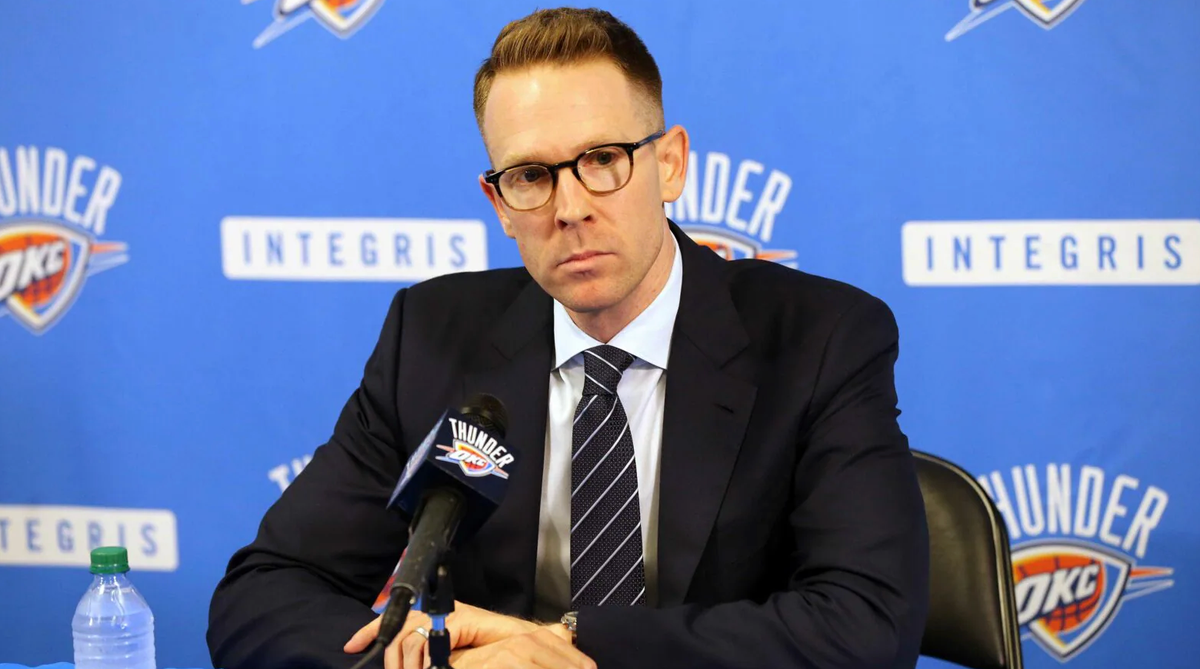
Sam Presti inherited a lottery team in 2007 and built two separate title-winning cores eighteen years apart — the first dissolved through player departures and ownership constraints, the second won the 2025 championship. The central question isn't whether he can identify talent, but whether small-market discipline can hold elite cores together long enough to win, then sustain them without breaking what works.
The Scorecard
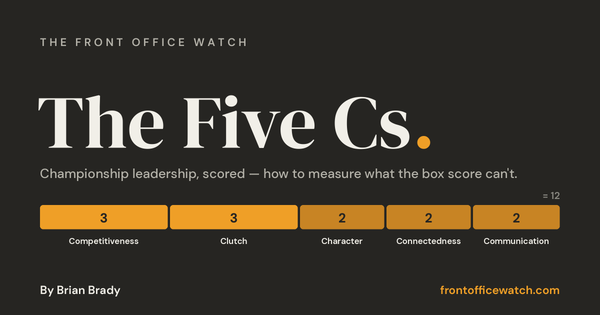
| Phase Diagnosis | 8/10 |
| Asset Extraction | 9/10 |
| Cornerstone ID | 8/10 |
| Assembly Discipline [constraint: 2012 luxury tax aversion] | 7/10 |
| Execution Under Pressure | 8/10 |
| Overall | 8.0/10 |
Decision authority: Sole Architect (2007–2012) → Sole Architect with ownership constraint (2012–2016) → Sole Architect (2016–2019) → Sole Architect (2019–2022) → Sole Architect (2022–present)
Presti scores as an elite GM across nearly every metric, constrained only by documented luxury tax aversion during the 2012 Harden decision. His asset extraction — particularly the 2019 Paul George trade that netted five first-round picks and Shai Gilgeous-Alexander — ranks among the best in NBA history. The 2025 championship validates an 18-year methodological approach that survived two complete rebuilds.
Who He Replaced — And Why
Presti replaced Rick Sund, who was demoted to consultant after Seattle's 31-51 season in 2006-07. The franchise was in active transition: Clay Bennett's ownership group had purchased the team from Howard Schultz with a conditional commitment to pursue a Seattle arena deal, though relocation to Oklahoma City was already suspected. The roster featured aging stars Ray Allen and Rashard Lewis, both approaching free agency decisions. Most importantly, Presti inherited the #2 pick in the 2007 draft — three weeks after being hired — giving him immediate franchise-altering leverage.
The organizational context was fractured. Bennett had to demote Sonics president Lenny Wilkens to "vice chairman" to establish clear authority for his 29-year-old hire. Presti arrived as the second-youngest GM in NBA history, recommended by San Antonio's R.C. Buford after seven years climbing the Spurs hierarchy. His Spurs pedigree — three championships as a front office member — provided credibility, but he faced immediate skepticism from a Seattle fan base already suspicious of ownership's intentions. The franchise would relocate to Oklahoma City within 14 months of his hire, making Presti simultaneously the last Sonics GM and the first Thunder executive.
The Phase Analysis
Presti's tenure divides into two complete organizational cycles, each moving through Reset, Assemble, and Calibrate — with the second cycle now in Sustain after the 2025 championship. His phase diagnosis has been consistently accurate, with one notable constraint-driven exception.
Reset Phase (2007-2009): Presti correctly identified the inherited team as fundamentally broken despite Allen and Lewis's All-Star status. Rather than attempting a competitive rebuild, he immediately traded Allen to Boston and executed a sign-and-trade with Lewis that generated a $9 million trade exception. The Lewis exception was immediately converted into Kurt Thomas's contract plus two Phoenix first-round picks — an asset extraction move with zero short-term competitive benefit. This chain (Lewis → exception → Thomas → picks) demonstrated clear Reset thinking from day one: accumulate, don't compete, hunt the cornerstone.
Assemble Phase (2009-2011): With Durant (2007) confirmed as the cornerstone and Westbrook (2008) and Harden (2009) acquired to build the supporting cast, Presti correctly read the team's transition into Assemble. The Thunder improved from 23-59 to 50-32, making the playoffs as the youngest team in NBA history. By 2011, they reached the Western Conference Finals. The Assemble execution was textbook — high-value draft picks, restrained free agency, no premature win-now moves.
Calibrate Phase (2011-2016): The Thunder advanced to the 2012 Finals, posted consecutive 59+ win seasons, and made four Western Conference Finals in six years. The cornerstone (Durant) was confirmed, the supporting cast was in place, and the structural problem to solve was experience plus depth — surgical work. Presti's phase read was correct, but the Harden trade created the defining constraint of this era. Multiple sources confirm luxury tax aversion drove the decision — whether from ownership mandate or organizational consensus remains contested, but the outcome was identical. Under the framework, this is the cleanest example of a GM correctly reading the phase while being forced into a discipline failure by ownership constraint. Calibrate demands keeping the right pieces and making surgical additions; the Harden trade was a Sustain-pricing move imposed before Sustain was earned.
Reset Redux (2016-2019): After Durant's departure, Presti's phase diagnosis became temporarily clouded. His decision to retain Westbrook and acquire Paul George represented a bet on staying competitive rather than rebuilding. This gamble produced first-round exits in 2018 and 2019, suggesting a temporary phase misread — though George's 2018 re-signing validated the competitive approach in the moment. By the new framework's standard, this was a Calibrate attempt without a cornerstone diagnosis sufficient to justify it — Westbrook alone, post-Durant, was not a confirmed cornerstone of the kind the framework requires.
Reset/Assemble (2019-2024): When George requested a trade in 2019, Presti executed the phase transition flawlessly. The "pivot" letter to fans acknowledged the rebuild explicitly. The subsequent asset accumulation — 38 draft picks at peak — and the development of SGA, Holmgren, and Jalen Williams demonstrated textbook Reset-to-Assemble discipline. The Assemble work was anchored to a confirmed cornerstone (SGA, who emerged from the George trade and developed into MVP-level production), with Holmgren and Williams forming the cast around him.
Calibrate Transition and Sustain Era (2024-present): The 2024-25 season was Calibrate — cornerstone and cast in place, the structural problem (lack of veteran physicality for playoff basketball) diagnosed and fixed surgically with the Hartenstein signing and Caruso acquisition. The 2025 championship moved OKC into Sustain. The phase imperative now shifts: don't break what's working. Presti's challenge becomes Bob Myers-2017-style restraint — resisting the unnecessary trade, maintaining the development pipeline, sustaining the culture as the founding core ages into prime.
The Marquee Decision
The James Harden trade on October 27, 2012, remains the defining decision of Presti's career — and the one he publicly acknowledged critics "may have had a point" about during his 2025 Hall of Fame speech.
The pressure was immediate and public. Harden had rejected OKC's four-year, $55-60 million extension offer, seeking the full max that Houston could provide. The luxury tax implications were stark: retaining Harden would have pushed OKC's payroll to approximately $86 million in 2013-14, well above the tax threshold, in a small market already losing money under revenue sharing. Yahoo Sports confirmed that "a consensus was reached among owner Clay Bennett, Presti, and assistant GM Troy Weaver: James Harden had played his last game with the Thunder."
Presti executed the trade within hours of the contract rejection, sending Harden to Houston for Kevin Martin, Jeremy Lamb, and multiple picks that yielded Steven Adams at #12 in 2013. His public defense was unequivocal: "Our ownership group was nothing short of spectacular, I want to emphasize that. They put us in position to make several substantial offers." He framed the timing as leverage maximization: "The value in a trade was greater based on the fact that the Rockets could offer him the contract he was seeking."
The outcome speaks for itself: Harden won MVP in Houston in 2018; the Thunder never returned to the Finals with their remaining core. Presti's Hall of Fame acknowledgment eighteen years later — "They may have had a point" — represents the closest he has come to publicly questioning the decision that broke up a potential dynasty. Under the framework, the trade is the textbook violation of Calibrate discipline: the cast was complete, the structural fix was internal continuity, and the cost imposed was the wrong cost at the wrong phase.
The Metric-by-Metric Read
Phase Diagnosis: 8/10. Presti correctly identified every major phase transition except the 2016-2019 Westbrook era, where his bet on competitive retooling without a confirmed cornerstone produced consecutive first-round exits. His 2007 immediate Reset and 2019 pivot were executed before media consensus caught up. The 2022-2024 Assemble timing was precise — the team improved from 40 wins to 57 wins to 68 wins as planned. The 2024 surgical Calibrate moves (Hartenstein, Caruso) demonstrated phase recognition at the highest level.
Asset Extraction: 9/10. The 2019 Paul George trade ranks among the most lopsided in NBA history — five first-round picks, two swaps, plus SGA for a player with one year remaining. Presti's leverage creation was masterful: Lawrence Frank's deposition confirms Presti told the Clippers they were "going to make him available to a couple of teams" despite knowing the Clippers were desperate for Kawhi Leonard's conditional signing. The Rashard Lewis → Kurt Thomas chain in 2007 and the Giddey-for-Caruso swap in 2024 demonstrate consistent extraction ability across different leverage positions.
Cornerstone Identification: 8/10. Presti drafted Durant, Westbrook, and Harden in consecutive years, then acquired SGA via the George trade and developed Holmgren and Jalen Williams. His hit rate on foundational picks is exceptional, and by the framework's diagnostic standard — locked in, available, sufficient prime years, primary engine on deep playoff success — both Durant and SGA cleared the bar definitively. The notable misses include trading Alperen Şengün (now All-Star level) and passing on various prospects, but his success rate on franchise-defining talent acquisition approaches elite levels.
Assembly Discipline: 7/10 [constraint: 2012 luxury tax aversion]. The Harden trade represents the clearest constraint-driven discipline failure of Presti's tenure — paying Sustain prices in Calibrate, forced by ownership economics rather than basketball logic. Post-2019, his cap management was exemplary — accumulating picks while avoiding mid-tier overpays, the textbook Reset-and-Assemble discipline. The 2025 extensions totaling over $800 million demonstrate evolved ownership support, but the Carmelo Anthony experiment and some veteran contracts (Kendrick Perkins) represent phase-skipping attempts that constrained flexibility. The score holds at 7 because the constraint flag contextualizes the Harden decision without erasing it.
Execution Under Pressure: 8/10. Presti's handling of trade requests has been consistently excellent. The George trade execution within days of the request, the graceful Durant departure press conference, and the rapid Westbrook trade all demonstrate leverage retention under maximum pressure. His coaching decisions — firing Carlesimo after 1-12, promoting unknown Mark Daigneault — show decisiveness in crisis moments.
The Unresolved Question
The most significant unresolved question is whether Presti can execute Sustain — the phase OKC entered after the 2025 championship — without breaking what works. With SGA ($272 million), Holmgren (up to $250 million), and Jalen Williams (potentially $287 million) all under extension, plus Isaiah Hartenstein's third-year team option at $28 million, OKC faces unprecedented payroll management challenges. The Sustain imperative is specific: resist the unnecessary trade, maintain the development pipeline, sustain the culture as the founding core ages into prime. The Warriors from 2016-2019 are the template Presti now follows; the Warriors after 2019 are the cautionary tale.
Secondary questions include Nikola Topić's development after missing the entire 2024-25 season with an ACL injury, and the potential franchise sale as Clay Bennett's ownership group — all over 65 — considers capitalizing on rising NBA valuations. The Thunder's contractual obligation to Oklahoma City through the new arena lease provides stability, but ownership transition could affect the luxury tax posture that enabled the 2025 championship infrastructure. A new owner with different economics could force Presti back into the same kind of constraint that defined the 2012 Harden trade — testing whether Sustain can survive a second imposed budget cut.
The Bottom Line
Sam Presti represents the definitive case study in small-market excellence — a GM who built two separate title-level cores through methodical asset accumulation and player development, then converted the second into the 2025 championship. His 18-year approach survived complete organizational teardowns, star departures, and ownership constraints that would have broken most executives. The site's Build Cycle classifies OKC as the only franchise to execute Path B twice — converting superstar departures into assets and rebuilding back to title-level without bottoming out. Presti's ledger is the clearest existing proof the build cycle can be mastered.
The Harden trade remains the caveat that prevents universal acclaim, but Presti's own acknowledgment of critics having "a point" demonstrates the self-awareness that distinguishes elite executives from defensive ones. His current challenge — executing Sustain while operating above the luxury tax for the first time in franchise history — will determine whether the 2025 championship represents vindication or the ceiling of what sustained discipline can achieve.
The post-championship extensions demonstrate evolved ownership support, but also create the highest-stakes test of Presti's career. As a rival executive noted: "He's going to try to use every piece that he can — every aspect of the trade, every trade exception, every draft pick, every little thing — and he's going to try to make something out of it." The Sustain question is whether those pieces remain sufficient when the imperative shifts from accumulation to preservation, and whether the small-market discipline that built two championship-level cores can also be the discipline that keeps one intact.
The full sourced research behind this profile, including phase-by-phase move analysis, direct quotes, and citations.