The Phase Report, Part 1: Reset Teams
Eleven NBA franchises have no confirmed cornerstone. Here is what each one should do about it this summer.
Reset.
Thirteen NBA franchises have no confirmed cornerstone. Here is what each one should do about it this summer.
Thirteen NBA franchises have no confirmed franchise cornerstone.
That single fact determines what every one of those thirteen front offices should be doing this summer. Not the cap space. Not the coaching situation. Not the ownership dynamics. Those are tools. Get the phase wrong and every correct-looking decision leads somewhere wrong.
The standard is five bars: contracted, available, sufficient prime years, proven as the primary engine of a winning team against elite competition, and established as the organizational leader.
The problem is math. Roughly four players per draft have genuine franchise cornerstone potential. This year those four go to Washington (#1), Utah (#2), Memphis (#3), and Chicago (#4). The lottery winners get the realistic cornerstone candidates. Everyone else is working with meaningfully lower odds.
That does not mean the other nine Reset teams are helpless. Picks #6-14 produce championship-caliber players regularly — SGA at #11, Mitchell at #13, Haliburton at #12 — but with an important distinction. Some become primary cornerstones. Others become elite co-stars who require a primary engine alongside them. Both outcomes are valuable. Only one resolves the Reset. A team picking in the #6-14 range needs a primary engine — and finding one there requires both elite scouting and genuine development infrastructure.
Picks #15-30 produce exceptions, not expectations. Giannis at #15. Kawhi at #15. Butler at #30. All outliers with specific identifiable reasons for falling. None of them a strategy to plan around.
Six paths to a cornerstone
Every Reset team not in the top four has six paths available:
- Path 1. Draft one in a future lottery.
- Path 2. Trade for a proven star.
- Path 3. Trade up within this draft by consolidating pick reserves.
- Path 4. Find the exception in the #6-14 range through elite scouting and development.
- Path 5. Accumulate enough picks in the #15-30 range that volume raises probability.
- Path 6. Develop the candidate already on the roster.
The worst Reset move regardless of path: spending picks or cap space on veterans who make the team marginally better without resolving the cornerstone question. The second worst: carrying a cornerstone-level salary for a player who cannot confirm the role while premium draft assets arrive into the confusion.
Here is where all thirteen teams stand.
They got the picks. Now what?
Washington Wizards
2025-26: worst record · #1 pickGM Will Dawkins (2 yrs) · Coach Brian Keefe
Dawkins ran the most sophisticated Reset execution in the league this year. He acquired Trae Young from Atlanta without surrendering Washington's own picks, then absorbed Anthony Davis from Dallas as a deliberate tank accelerant. The result: worst record, #1 pick, and Davis still available as a tradeable asset. That is what learning from Sam Presti for seven years produces.
The Trae Young extension structure and the development infrastructure around Brian Keefe. Dawkins has the asset side mastered. The cornerstone work runs through both.
Deeper read
What Dawkins said. "We do know that we're rebuilding... We possess a clear vision for our future, and we have crafted a strategy to achieve it." After the Davis trade: "We're not all in. This isn't a push-go, everybody go-move." A GM who names the phase publicly and refuses to perform false ambition.
How the Davis acquisition actually worked. Dallas needed to clear Davis. Dawkins absorbed him using only inherited weak picks — neither was a Washington-originated first. Washington then kept Davis off the court deliberately to lose games. The franchise won the #1 pick and still holds Davis as a trade chip with real name value. Minimum cost in, maximum optionality out. The asymmetry is the point.
Trae Young is a bridge vet, not a cornerstone candidate. Young's cornerstone window was 2021 — he won two playoff series as Atlanta's primary engine, then never returned to that level. The Atlanta era has ended. Trying to recast him as Washington's cornerstone — at 27, with five years of post-2021 evidence pointing in the wrong direction, on a team about to draft AJ Dybantsa #1 — would be the kind of mistake that erases the asset work Dawkins just executed. The right structure is a two-year deal with a team option on the third, so Washington has a competent veteran orchestrating the offense while Dybantsa develops, with flexibility to pivot if Dybantsa grows fast.
The Keefe gap. A first-year head coach with no development track record receiving the #1 pick is the biggest unresolved variable in Washington's Reset. Dawkins has built strong drafting infrastructure. The development infrastructure is unproven. The gap between those two is where #1 picks are confirmed or wasted.
The portfolio mindset. Dawkins and Michael Winger have confirmed publicly that Washington does not feel compelled to keep #1 if the right offer arrives. A GM treating the #1 pick as a tradeable asset rather than a certainty is thinking in portfolio terms — which is what a sophisticated Reset looks like.
Utah Jazz
2025-26: lottery · #2 pickGM Justin Zanik (4 yrs) · Coach Will Hardy
Three years of patient Reset work delivered exactly what patience is supposed to deliver. Zanik traded Gobert and Mitchell correctly. He lost. He resisted the pressure to look competitive. And the lottery rewarded him with Darryn Peterson at #2. The infrastructure receiving him is credible — Walker Kessler under Hardy's system, Keyonte George developing, Hardy signed long-term. There is almost no gap between what Zanik has said publicly and what he has done. That is rare in this group.
Whether Zanik resists the temptation to deploy cap space on veterans now that the cornerstone has arrived. The Assemble work begins. The Reset discipline still needs to hold.
Deeper read
What Zanik said. On free agency restraint: "We are extremely aggressive with pursuing any and all means necessary to make this a championship-caliber roster. When those opportunities come up, we're ready for it. There weren't any. And so to sit there and not do anything, we decided that our plan was to completely throw our focus into our young guys." On the phase itself: "We are currently in a phase of assessment and development." A GM whose public posture has matched his actions across three full Reset cycles.
The infrastructure receiving Peterson is the strongest in the lottery group. Walker Kessler became an elite shot-blocker under Hardy's defensive system. Keyonte George shows real lead-guard development at 22. Hardy is signed through the back end of this decade and has earned genuine development credibility. Peterson arrives into a coaching staff, system, and young-player culture that was built specifically for him.
The Path 6 question. Keyonte George is already on the roster at 22. If George develops into a primary engine alongside Peterson, Utah may have identified two cornerstone-level talents through patience. That is the OKC model — Durant plus Westbrook, then SGA plus Williams. It is not guaranteed. But Hardy's system has earned the benefit of the doubt on the question, and George's age means there is real runway.
The risk hiding inside success. Patience that produced the #2 pick is harder to maintain than patience that produced losing seasons. The pressure to spend cap space on veterans who make Utah look like a playoff team in 2026-27 will be real. The framework's Assemble phase calls for restraint at exactly this moment — Peterson needs the runway to confirm before the cast around him gets expensive. Zanik's record suggests he won't compress the timeline. The temptation is still real.
Memphis Grizzlies
2025-26: 25-55 · #3, #16 picksGM Zach Kleiman (7 yrs) · Coach Tuomas Iisalo
Kleiman is a legitimate talent evaluator — Executive of the Year in 2021-22, Desmond Bane at #30, GG Jackson at #45. The drafting infrastructure is real. But premium Reset assets are arriving into an organization that has not publicly declared what phase it is in. Trading Ja Morant was a "fantasy" in April 2025. By February 2026 the team had traded Jaren Jackson Jr. and Bane, and Kleiman was publicly evaluating whether Morant was "taking consistent action that leads to consistent positive outcomes." That is not a GM who changed his mind. That is a GM who knew the phase and could not declare it because the declaration itself was costly.
Whether Kleiman resolves the Morant question before the picks arrive. A declared Reset with confirmed development infrastructure is what these picks deserve. Continued phase ambiguity is the most expensive thing this organization can hold onto.
Deeper read
What Kleiman said — in sequence. April 2025: "I can't fault other executives for dreaming about us trading Ja. But that's just what it is — a fantasy. Underestimate Ja, this team, and this city at your own risk." February 2026, ten months later: "Ja remains a member of the team. We evaluate all our players... whether they're taking consistent action that lead to consistent positive outcomes for the team." April 2026: "I'm not going to speculate on potential transactions." A public reversal without a public declaration.
The Morant contract is the cost of declaring Reset. Morant carries $127 million remaining. Publicly declaring Reset would crater whatever trade value that contract still holds. The reversal in tone is not the framework's specific indictment. The indictment is that the phase declaration was held back to protect the asset rather than to name the truth. That choice has organizational costs that compound across coaches, picks, and culture.
The Jenkins firing was a phase recalibration in disguise. Taylor Jenkins was fired with nine games remaining, after a 14-23 collapse. Iisalo runs a pace-and-space system built for young player development. That is correct phase recognition. Kleiman removed the Calibrate coach and installed the Reset coach without publicly saying that was what he was doing. The action was right. The reluctance to name it tells the same story as the Morant quotes.
Morant's 2025-26 season makes the question more urgent. He played 20 games before a UCL injury. The organization suspended him in November for conduct detrimental to the team. He told reporters publicly he had "lost his joy." Premium Reset assets — the #3 pick, the #16 pick, the picks that will arrive next year — are about to enter that situation. The framework's standard is straightforward: either commit to Morant with a documented behavioral and health timeline, or trade him while the contract still has value. Both choices are defensible. Neither requires another year of unresolved ambiguity.
The picks deserve a declared phase. Kleiman is too good an evaluator for this to be a process failure. It is a stalling decision dressed as patience. The first sentence of an actually-declared Reset would resolve more than any individual transaction this summer.
Chicago Bulls
2025-26: dumped at deadline · #4, #15 picksGM Bryson Graham (1 month) · Coach TBD
Chicago dumped the roster at the deadline, fell to #4, and hired Bryson Graham — a first-time GM whose introductory quotes show he knows the brief. The position is real: top-four pick in a four-cornerstone draft, a second first at #15, $68-72M in cap space, no veteran commitments to manage. Three decisions define his first summer: the picks at #4 and #15, the coaching hire, and whether the cap space gets used as an asset or spent like one.
Whether Graham hires a proven development coach and uses cap space to generate more lottery-tier swings rather than buy win-now veterans. Chicago already has two firsts in this draft. The path forward is stacking more chances at the cornerstone, not signaling competitiveness.
Deeper read
What Graham said. At his introductory press conference: "It's going to take time. I think the roster — we're in the developmental stage right now." After winning #4: "Let's not sit here and say because we have the fourth pick all of a sudden this franchise is back. It's just a good opportunity to add high-level talent to our group. Giannis went 15. Kawhi went 15. Devin Booker went 12. Maxey went 21." On draft philosophy: "Trying to find a fit is not the right way to approach it. You try to take the best player." A GM who, on day one, names the phase and refuses to perform false ambition.
The #4 pick is not a guarantee. The framework treats picks #1-4 as the lottery cornerstone tier, but the variance inside that tier is real. Chicago itself drafted Patrick Williams at #4. Graham should not behave as if his #4 pick is automatically Chicago's next cornerstone. The #15 is already a second swing in this draft, which is the right hedge. The question is whether Graham can convert his cap space into a third — through bad-contract absorption that brings back future firsts — rather than spend it on visible veterans.
Cap space is the asset. The deployment is the test. $68-72M in cap space is the largest in the league. The wrong move is spending it on veterans who make Chicago marginally better — that is the exact pattern that produced the Vučević trade in 2021 and led to five years of treading water. The right move is using cap space as a pick-generation engine: absorbing bad contracts from tax-paying teams in exchange for future firsts. At least two contenders this summer would attach a first to move off the wrong veteran salary. Chicago is the team best positioned to take those deals. Whether Graham executes that play — or spends the cap space on visible veterans to signal ambition — will tell us more about him than the draft picks themselves.
The coach hire is the bigger decision than the pick. The development environment for whoever Chicago selects at #4 and #15 depends entirely on the next head coach. A franchise pick arriving into the wrong development environment is one of the most expensive Reset mistakes a GM can make — and Chicago has no internal development infrastructure to lean on if the head coach lacks one. The bar for this hire isn't NBA experience or playoff résumé. It's documented development of young talent through years one through three.
The question nobody asked Graham. Graham arrived in Chicago with a reputation for talent evaluation built in New Orleans, where the Pelicans' draft room found Zion Williamson, Herb Jones, Trey Murphy, Dyson Daniels, and Yves Missi. That is a real track record. And yet the Zion-era Pelicans never won. Either Zion's availability and conditioning were the failure — in which case Graham's talent eye is intact — or the players Graham helped surround Zion with were not the right ones. Nobody at his introductory press conference asked him to account for it. The honest answer would tell us more about how he'll build around Chicago's #4 pick than any of the philosophical quotes he offered instead.
No lottery cornerstone pick. Six paths. Decreasing probability. Each one a different test of whether the GM understands the phase.
Brooklyn Nets
2025-26: 26-56 · #6 pickGM Sean Marks (10 yrs) · Coach Jordi Fernández
The most disciplined Reset execution in the league not named Oklahoma City. Five first-round picks in the 2025 draft. No long-term veteran commitments despite two consecutive lottery misses at maximum odds and persistent public pressure to accelerate. Marks absorbed the criticism and held the course. That is genuinely rare. Brooklyn picks sixth — in the #6-14 window where championship-caliber players emerge but where finding the primary engine requires both elite scouting and the willingness to be patient through year-three uncertainty.
Whether Marks treats the #6 pick as the answer or as one card in a portfolio. Brooklyn's pick depth makes consolidation conversations real. Using #6 on a safe selection without exploring whether the assets could buy a higher position is the framework's specific concern.
Deeper read
What Marks said. After falling to #6: "There's going to be some really good options for us, whether we are picking one or whether we are picking 10. With multiple assets that we have in this draft, multiple future assets, we're going to continue to build this team up into hopefully something we can be really proud of." On the broader posture: "We don't want to get sped up. We've talked multiple times about being systematic and strategic in how we build here." On asset positioning: "We've maintained flexibility, we've got the cap space and assets. The word would be: opportunistic." A GM whose words match the framework's prescription almost line for line.
The development infrastructure is real. Marks has found genuine value in the #15-30 range — Cam Thomas, Dariq Whitehead — and Fernández has produced documented year-two improvement in both. That matters for what Brooklyn can do at #6. Picks in the #6-14 range produce championship-caliber players regularly, but only with the kind of scouting and player development infrastructure that converts upside into outcome. Brooklyn has both.
The interesting question is whether Brooklyn should use #6 at all. Their pick-rich status makes consolidation conversations live. The Nets hold their own future firsts plus multiple firsts from the Phoenix and Houston deals. That is the kind of portfolio that lets a GM go to other GMs and ask whether a top-three position is available for the right combination of present and future assets. The framework doesn't draft trade proposals. But the question Marks should be asking — and that other GMs in his position routinely fail to ask — is whether the assets in hand could buy a cornerstone-tier pick rather than settle for the cornerstone-possible one.
The Reset clock starts compounding. Two consecutive years of maximum lottery odds without converting to a top-four pick is the kind of variance that tests organizational patience. Brooklyn's ownership has been disciplined so far. But Marks is now in year three of a stated Reset with no confirmed cornerstone identified. The framework is sympathetic — Reset is hard, lottery variance is real, the discipline is the right discipline. The question whether sympathy is shared inside the building going forward is one Marks will have to manage in addition to the basketball decisions.
The verdict. Brooklyn is doing the Reset correctly. The remaining question is whether the GM can convert correct process into a cornerstone outcome, which is a question Reset GMs cannot answer through process alone. At some point a name has to emerge. Whether it emerges at #6 this summer or through consolidation into a higher pick is the diagnostic decision Marks faces.
Sacramento Kings
2025-26: lottery · #7 pickGM Scott Perry (1 yr) · Coach Doug Christie
Perry's words are right. "Finishing in the play-in zone every year is probably the worst place to be" is the Reset math in one sentence — and Perry said it publicly. The question is whether the LaVine contract and the Sabonis situation allow him to act on what he knows. Two secondary stars without a confirmed cornerstone is a worse Reset position than one. Sacramento's path forward runs through resolving the LaVine question by June 29 — and the player option deadline may force the decision regardless of what Perry would prefer.
The LaVine player option deadline on June 29. Whether Perry's stated phase clarity survives the contract decisions that follow. The Spurs 2027 unprotected first is Sacramento's most valuable asset for any path beyond #7.
Deeper read
What Perry said. "We're at the extremely early stages of laying the foundation here. You've heard the phrase from me, prudent and patient." On the trap: "Finishing in the play-in zone every year is probably the worst place to be." On process: "I don't believe in what I refer to as overnight successes... it involves years of drafting, nurturing talent, and making trades." On discipline: "We're not going to pursue flashy options just for the sake of it." A GM who has named the phase correctly. The question is execution under constraint.
The LaVine question is forced by the calendar. LaVine has a $49 million player option with a June 29 deadline. Sacramento was actively exploring ways to move that contract through the spring. Whether Perry trades LaVine, lets the option get exercised and trades him later, or extends him at lower number to facilitate a trade — all three are different bets on what Sacramento's Reset actually looks like. The framework's standard: the LaVine decision should be made because it's the right basketball decision for the phase, not because the calendar forced it.
The Sabonis situation is the second layer. Sabonis is a top-tier non-alpha big — All-Star, durable, productive. He is also 30, on a long-term contract, and not the kind of player around whom an alpha cornerstone is typically built. A GM in true Reset would already have explored what Sabonis can return on the trade market. Perry has not signaled that he has, which is the second test of whether his words translate to actions.
The development infrastructure is the weakest in the Reset group. Christie enters year two with no confirmed development track record. The Kings have not produced a developed lottery success since the run that brought Fox, and Fox is now elsewhere. A #7 pick arriving into a development environment that has not proven itself is the framework's specific concern. The honest standard isn't whether Christie can win games. It is whether he can develop a 19-year-old into a primary engine through years one through three.
The asset that matters most. The Spurs 2027 unprotected first is Sacramento's single most valuable trade chip — projected to land in a draft regarded as deeper than 2026. That pick is the kind of asset that buys real movement: a star, a higher pick this year, or a cleaner cap reset. The Reset question for Perry is what he can extract from it. Holding it as optionality has value. Spending it on the wrong veteran would be the kind of move that ends a Reset before it begins.
Atlanta Hawks
2025-26: 31-51 · #8 pickGM Onsi Saleh (1 yr) · Coach Quin Snyder
Jalen Johnson averaged 22.5 / 10.3 / 7.9 in 2025-26 and made All-NBA Third Team. The case for him as a confirmed cornerstone is growing. The framework keeps Atlanta in Reset anyway because cornerstone confirmation requires playoff evidence as the primary engine — and Atlanta finished 31-51. Saleh inherits a strong draft room and Snyder's documented development track. The right move at #8 is conviction. The wrong move is treating Johnson as confirmed when he is not yet.
Whether Saleh commits Assemble-level capital around Johnson before Johnson clears the cornerstone bar. The Trae Young trade gave Saleh his Reset on day one. Spending that runway too early is the framework's specific concern.
Deeper read
Johnson's case is real. 22.5 points, 10.3 rebounds, 7.9 assists. All-NBA Third Team. Locked in. Available. Sufficient prime years. A player league-wide treated as a foundational piece. By every cornerstone criterion except the playoff one, Johnson clears the bar. That last criterion exists for a specific reason.
The counter-argument and the framework's response. Johnson cannot prove the cornerstone bar on a 31-51 team because the bar requires winning, and the framework cannot fairly demand winning from a player whose GM has not yet built the team around him. By that logic every top player on a bad team is permanently unconfirmable. That is exactly the rationalization every franchise uses to justify premature Assemble acceleration. One more season of evidence — Johnson at the center of a real cast, against real playoff competition — is the honest standard.
The infrastructure is among the strongest in the group. Saleh's draft room — built during the Bryson Graham era in New Orleans, now anchored by Peter Dinwiddie — has a track record. Snyder's development results are documented: Johnson's emergence, Dyson Daniels' defensive transformation, the system that produced both. Atlanta at #8 with this staff is meaningfully different from a generic team at the same slot. The pick should land in a developmental environment that converts upside into outcome.
The Trae Young trade resolved Atlanta's cornerstone question by removing the wrong answer. Trading Young to Washington was not a Reset accelerator — it was a Reset clarifier. Atlanta has now publicly stated that the Trae Young era is over. That clears the path for Johnson to be evaluated as the actual cornerstone rather than the consolation alongside him. The framework's read: Saleh inherits a Reset that has already done the hardest cultural work. The harder work — patience — is still ahead.
The risk to watch. A 22-point, 10-rebound, 8-assist forward on a max contract creates organizational pressure to compete. The framework grades Calibrate-level commitments around provisional cornerstones harshly because the downside is asymmetric — if Johnson plateaus, the assets spent to support him become the things blocking the next Reset. The correct move is the boring one: use #8 with conviction, keep the cap clean, let Johnson prove the cornerstone bar himself.
Milwaukee Bucks
2025-26: 32-50 · #10 pickGM Jon Horst (8 yrs) · Coach TBD
Giannis appeared in 36 games. Lillard's contract was stretched. Both sides are reported aligned on separation. Horst is publicly describing the relationship as potentially requiring "couples therapy" while simultaneously saying he doesn't know what he's going to do. That is not paralysis. That is an organization that has diagnosed the situation and has not yet found the courage to act publicly. The assets, as Horst says, will still be there. The question is whether they will be worth as much by then.
Whether Horst executes the Giannis trade at trough value or waits another year and watches it decline further. The player option in 2027-28 means waiting costs Milwaukee the option window entirely. Trough value today is worth more than floor value in two years.
Deeper read
What Horst said. "The truth is I don't know. We don't know what we're going to do today, and we don't have to." On the Giannis dynamic: "Whether we need 'couples therapy' or whatever, the assets will still be there. I do feel empowered that, yeah, those things are both viable things for us to look at and consider." On the team itself: "I'm not making excuses. I'm not saying this was a perfectly built team. We might have overcalculated or miscalculated on whatever." A GM who knows what the situation is and is publicly performing the indecision.
"The assets will still be there" is the most expensive sentence in this dataset. It is true in a literal sense — Giannis remains under contract, his name still has value, picks can still be acquired. It is false in a strategic sense. Every month of drift converts Giannis's trade value from trough toward floor. The market knows Milwaukee must move him. That is not leverage. That is the inverse of leverage.
The Lillard mistake compounds the Giannis decision. The Lillard acquisition was the Calibrate move that broke Milwaukee's title window. Stretching his contract bought cap relief but signaled organizational acknowledgment that the Lillard era ended without producing a championship. Horst now has to execute Reset under the constraint of having spent Calibrate capital in the wrong moment. That makes the Giannis trade harder, not easier. The cleanest reset starts from a clean cap. Milwaukee does not have one.
The coaching question is downstream of the cornerstone question. Without a confirmed coach in place, the #10 pick's value depends on a development environment Milwaukee has not yet built. The right sequence is: trade Giannis, hire the development coach who matches the post-trade roster, then evaluate #10 in context. Doing #10 first is the kind of move that produces another wasted year.
The framework's verdict. Horst has diagnosed correctly. He has not yet acted on the diagnosis. The cost of inaction is asymmetric: every month that passes makes the Giannis return smaller and the Reset clock longer. The honest move is the one Horst's quotes are circling without naming. Saying it would resolve more than holding it.
Golden State Warriors
2025-26: play-in exit · #11 pickGM Mike Dunleavy Jr. (3 yrs) · Coach Steve Kerr
Dunleavy has never publicly used the word "reset" or named the Warriors as rebuilding. His public posture is consistently Calibrate language — targeted improvements, injury explanations, championship pursuit. That language is the evidence of misdiagnosis. Curry is no longer a forward-looking cornerstone. The team's title window has closed in everything but rhetoric. The #11 pick can begin the next era's foundation. It cannot do that if the surrounding capital remains committed to the wrong phase.
The Draymond decision and whether the cap space gets spent on Calibrate-era veterans for one more chase. The honest reset starts with naming what era is over. The Warriors are not in 2017 anymore.
Deeper read
What Dunleavy said. "As long as Steph, Draymond, Steve — as long as they've still got their fastball, we're going to keep pursuing titles." On Draymond's future: "We've had discussions where we would like him to conclude his career as a Warrior. He seems to share the sentiment. I anticipate his return." Post-Kerr extension: "This just isn't about the roster, frankly. This year I don't think we came up short because of the talent on the roster. It was injuries and things we could control." A GM publicly maintaining a phase the basketball evidence has already left behind.
The case against calling Reset is real. Curry and Butler together went 42-18 when both were healthy — a 68-win pace. That is not a small sample. The framework is not arguing Curry isn't extraordinary. The argument is probabilistic, not qualitative. The chance of Curry and Butler both being healthy for a full playoff run at 38 and 37 has dropped below the threshold where committing surrounding capital to an Assemble or Calibrate posture is rational.
"I anticipate his return" is the gap in four words. The framework prescribes trading Draymond while he can still command a real return — a future first, a young rotation piece, possibly a 2027 pick swap with a non-contender. Dunleavy is publicly signaling the opposite. Organizations rarely make the right Reset decision when comfort aligns against it. That is the Golden State problem in its purest form. Not malice. Comfort.
The Curry question deserves more honesty than it's getting. Curry is a confirmed cornerstone — past tense. He's a confirmed legend — present tense. He is not a confirmed forward-looking cornerstone because the framework's cornerstone bars include sufficient prime years remaining. At 37, with diminishing availability and the inevitable physical decline, Curry has perhaps one more title-credible season left, and only if the cast around him is exceptional. That is not a phase to spend the next era's capital on.
The development infrastructure is genuine. Dunleavy has found real contributors at this pick range — Moody at #14, Kuminga at #7, Podziemski at #19. The infrastructure works. The #11 pick can begin the Reset foundation. It cannot solve the Reset problem if the surrounding cap remains committed to the era that is ending.
The framework's verdict. Trade Draymond while he can command a real return. Honor Curry honestly — name the era. Let the #11 pick begin the foundation of what comes after. Anything less is comfort masquerading as plan.
Miami Heat
2025-26: 37-45 · #13 pickPresident Pat Riley · GM Andy Elisburg · Coach Erik Spoelstra
Bam Adebayo is 28, on a max deal, and has anchored two Finals runs. The case for treating him as confirmed is not crazy. The framework's distinction: Adebayo has never been the primary offensive engine of a winning team against elite competition. He has always been the second or third option. Without a confirmed primary engine, Miami is structurally a .500 team. The #13 pick with Riley, Elisburg, and Spoelstra is categorically different from a generic team at the same slot — but only if the cornerstone question gets diagnosed correctly.
Whether Miami pursues Path 4 with elite conviction at #13 — Adebayo at #14, Herro at #13, this is the staff for it — or treats Adebayo as the cornerstone and spends around him. The Giannis market is real. Acquiring a primary engine without compromising the development infrastructure is the only Path 2 worth executing.
Deeper read
The Adebayo confusion is the most interesting cornerstone case in the Reset group. Two Finals appearances. A defensive identity built around him. A max contract. League-wide reputation as a culture piece. By every cornerstone criterion except one, he clears the bar. The one he doesn't clear is the most important: he has never been the primary offensive engine of a team that won at the highest level. Jimmy Butler was the engine of the 2020 and 2023 Finals runs. Adebayo was the foundation. Those are different roles. The framework grades the cornerstone question on what the player is, not what the organization needs him to be.
The Path 4 case is the strongest in the field. Miami's draft room found Adebayo at #14, Herro at #13, Nikola Jović. The development pipeline has produced rotation players from second-round picks. Spoelstra's system converts talent at a higher rate than any non-OKC operation in the league. If a primary-engine candidate is available at #13 this summer, Miami is the team best positioned to identify and develop them. That is the path.
Path 2 is live but dangerous. The Giannis market is real. Miami has the kind of cap mechanics and aging-veteran assets to put together a competitive offer. The question is whether acquiring Giannis without a complete surrounding infrastructure replicates the Vučević mistake at maximum scale. A 31-year-old superstar arriving onto a roster without a clear second engine and limited remaining draft capital is exactly the kind of move that compresses a Reset into a one-window Calibrate that fails. The framework's read: Path 2 only if the price doesn't compromise the Reset foundation. Most realistic prices would.
The Riley problem isn't Riley. Pat Riley has won at every era of the modern NBA. The risk is the institutional version of "I anticipate his return" — Miami's culture has historically expected to compete, and Reset language is foreign to the building. Whether Spoelstra and Riley can publicly name this Reset for what it is will determine whether the #13 pick lands in the right developmental environment. The cultural friction is the framework's quiet concern.
The verdict. Execute Path 4 with elite conviction at #13. Pursue Path 2 only if conditions emerge that don't compromise the foundation. Frame Adebayo correctly — as the foundational piece, not the primary cornerstone — and stop building as if the cornerstone question is settled.
New Orleans Pelicans
2025-26: 21-61 · no 2026 firstEVP Joe Dumars (1 yr) · Coach TBD
No first-round pick in 2026. Dumars's last front office job ended in Detroit in 2014 — defined late by the Josh Smith and Brandon Jennings contracts. No confirmed coach. Zion Williamson has played 276 career games across seven seasons. And Dumars is publicly describing the franchise as "not far from winning." That is the most alarming sentence in the entire Reset dataset. A GM with no pick, no coach, an unresolved Zion situation, and a franchise-level ownership mandate to win a first NBA title — describing the franchise as "not far from winning" — is either describing a different franchise or refusing to name the phase.
Whether Dumars makes the Zion decision explicitly and begins generating pick assets through creative Reset mechanics — including bad-contract absorption. The path forward starts with a declared phase. Right now there isn't one.
Deeper read
What Dumars said. "New Orleans is not far from winning. It's not some long rehaul process." On Zion: "We have no intentions of trading Williamson. We're going into the offseason looking forward to having Zion coming back next year and playing great again next year." On the mandate from owner Gayle Benson: "No edicts. None whatsoever... When me and Mrs. Benson talked, she said to me, 'Joe, I would love to know what it's like to win an NBA title.' That was it." A GM operating with the broadest possible mandate and the narrowest possible toolkit.
The Zion question is the entire diagnostic. Williamson has played 276 career games across seven NBA seasons — roughly 3.4 full seasons of availability across what should have been the prime years of a cornerstone career. He ended 2025-26 on a 35-game consecutive appearance streak before another injury. One streak does not satisfy the availability criterion when the career average is 40 games per season. The framework's standard: either commit to Zion with a documented behavioral, conditioning, and health timeline that addresses the entire body of evidence — or trade him while there is still any market for the name.
No pick is the unique constraint. Every other Reset team has at least one first-round selection this summer. New Orleans does not. That makes the standard creative-Reset move unavailable: there is no draft pick to develop, no #1-30 selection to begin building around. The path forward depends entirely on asset generation through other means — bad-contract absorption, the Trey Murphy / Herb Jones / Yves Missi trade discussions, the use of future firsts as the lever for present movement.
The creative move Dumars has not yet executed. At least two tax-paying teams have contracts they would move if someone took them cleanly. Dumars's Hall of Fame credibility gives him access to those conversations. That access — not the Zion situation — may be New Orleans's most underutilized asset. The play is: absorb a bad contract for a future first, then either keep the first or use it to acquire the cornerstone that the 2026 draft did not provide. Whether Dumars sees this play and executes it is the test of his first full summer.
The Detroit shadow. Dumars's track record is real — Bad Boys, 2004 championship as GM, Executive of the Year in 2003. But the late Detroit tenure is also real, and the Smith and Jennings contracts were Calibrate-era moves spent during what should have been a Reset. The framework's question for Dumars is whether the lessons of 2013-14 have been internalized or repressed. The "not far from winning" quote suggests the latter.
Portland Trail Blazers
2025-26: 42-40 · first-round exit · no 2026 picksGM Joe Cronin (4 yrs) · Coach TBD (Splitter interim)
The feel-good story with the most expensive bill in the Reset class. Tiago Splitter took over one game into the season and piloted Portland to 42 wins and its first playoff berth since 2021 — and that berth conveyed the team's lottery-protected first to Chicago, deferred since a 2021 trade. The play-in win everyone celebrated cost a premium asset. Meanwhile, the organization's behavior answers the candidate question without ever saying it out loud: Scoot Henderson — 30 games this season after a preseason hamstring tear, over a third of his career missed — returned to an off-ball hybrid role, has no extension, and watched the front office trade Anfernee Simons for Jrue Holiday and bring Damian Lillard home. An organization anchored on a 22-year-old candidate does not surround him with two veteran point guards and float interest in a 31-year-old supermax. Portland has real talent — Avdija, Camara, Clingan, Sharpe — and no anchor. That is Reset with a winning record, which is the most dangerous kind, because nothing about 42-40 feels like a phase that demands declaring.
The Scoot Henderson extension decision — anchor or hedge, and either answer is better than neither. New owner Tom Dundon's first full offseason, the permanent coaching hire, and whether 42 wins gets treated as a foundation or priced honestly as the play-in purgatory Scott Perry named: the worst place to be.
Deeper read
The conveyed pick is the whole lesson. Portland's 2026 first carried lottery protection that had rolled forward since a 2021 trade. Making the playoffs stripped the protection and sent it to Chicago — meaning the framework can put a price on the play-in run: one premium draft asset, paid by a team with no confirmed cornerstone to a team hunting one at #4. For a Reset franchise, winning 42 games was not free. It was the most expensive thing Portland did all year.
The Scoot file is genuinely mixed. The improvement is real: his on-court impact went from minus-13.9 per 100 possessions as a rookie to plus-2.9 this season — the Blazers were better with him on the floor. But the file also shows a preseason hamstring tear, 30 regular-season appearances, a move toward off-ball hybrid usage when he returned, and five total points on 2-of-13 shooting in the final two playoff games against San Antonio. The talent case is open. The availability case — over a third of his career missed in three seasons — is the bar his candidacy keeps failing.
The behavioral evidence cuts one way. Simons out for Jrue Holiday. Lillard back on a three-year deal. The candidate playing off the ball. No extension committed. And reported interest in Giannis Antetokounmpo through multi-team structures. Each move is defensible alone. Together they describe a front office hedging in every direction at once — which is the opposite of what Assemble-Candidate status requires. The phase isn't a grade of Scoot Henderson. It's a description of an organization that has not anchored on anyone.
The ownership variable. Tom Dundon's first full offseason, a permanent coaching search running past the interim who delivered the playoff berth, and a candidate extension decision all land in the same summer. New owners tend to want progress they can point to. The framework's concern is specific: 42-40 makes the wrong phase feel like the right one, and the most expensive misdiagnoses are the comfortable ones.
LA Clippers
2025-26: 42-40 · missed playoffsPresident Lawrence Frank · GM Trent Redden · Coach Ty Lue
Kawhi Leonard had a genuinely excellent year — roughly 28 a game at 34 — and it changes nothing about the diagnosis, because cornerstone is a structural role, not a talent tier. Leonard cleared the engine bar permanently in 2019; he fails prime years now, and the rule from the Durant case applies without modification: a cornerstone-caliber player who cannot be a cornerstone. The leadership bar compounds it: Leonard's lead-by-example quiet worked in Toronto because Kyle Lowry held the room, and there is no Lowry here. The rotation was the oldest in NBA history, the front office spent last summer adding Chris Paul, Bradley Beal, and Brook Lopez — Assemble-shaped moves with no one to assemble around — and the season ended at 42-40, out of the playoffs, with a pick cupboard thinned by years of win-now trades. No confirmed cornerstone, no candidate, no premium draft capital: the hardest Reset profile in the league, held by the organization least willing to say the word.
Whether anyone in the building names the era over. Every veteran contract on this roster still returns more today than it will in a year — the discipline test is converting them into the next era's assets before age converts them into nothing.
Deeper read
The Kawhi rule. What Leonard proved in 2019 is permanent — Finals MVP, the engine of a champion, against elite competition. What he cannot recover is time. A 34-year-old fails the prime-years bar regardless of how the most recent season looked, and the framework's vocabulary exists precisely for this case: cornerstone-caliber talent in a body that can no longer anchor a five-year build. A great year from an aging star is a reason to win now or to sell high. It is never a reason to re-diagnose the phase.
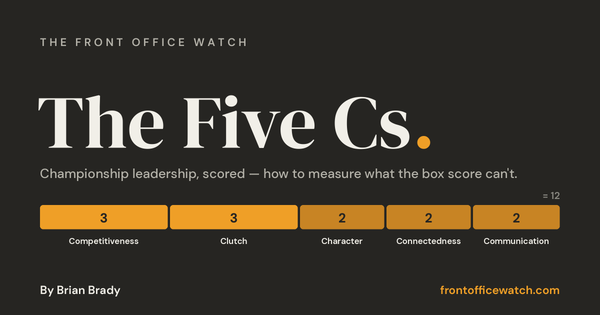
The leadership ledger. Run the room through the Five Cs and the structural problem sharpens. Leonard's leadership has always been lead-by-example quiet — which worked in Toronto because Kyle Lowry held the room, set the temperature, and made the quiet superstar model viable. There is no Lowry here, and no one on this roster who clears the leadership bar with prime years attached. The Clippers aren't just missing a cornerstone; they're missing the bar a cornerstone is supposed to clear by definition.
The roster math. The oldest rotation in NBA history got a year older and added Chris Paul, Bradley Beal, and Brook Lopez to fix it. Those are Calibrate-style moves — surgical veteran additions — executed by a team with no confirmed cornerstone to calibrate around, which is the same category error the framework documented in the Vučević trade: the move's quality is irrelevant if the phase is wrong. The result was 42-40 and a lottery finish in a season that began with title aspirations.
The asset clock. Years of win-now trades thinned the pick cupboard, which forecloses the standard Reset entry point. What the Clippers do hold is veteran salary that other contenders want — and every contract on this roster depreciates with each birthday. The framework's test for this front office is the one Bob Myers passed and this organization historically has not: the discipline to convert value before it converts to zero. The longer the era goes unnamed, the less the next one starts with.
| Team | GM | Pick | Best path | Biggest risk |
|---|---|---|---|---|
| Washington | Dawkins | #1 | Path 1 | Young extension structure |
| Utah | Zanik | #2 | Path 1 | Patience after success |
| Memphis | Kleiman | #3, #16 | Path 1 | Morant phase undeclared |
| Chicago | Graham | #4, #15 | Path 1 | Coaching hire + cap deployment |
| Brooklyn | Marks | #6 | Path 3 or 4 | Choosing explicitly |
| Sacramento | Perry | #7 | Path 4 | LaVine option deadline |
| Atlanta | Saleh | #8 | Path 4 or 6 | Johnson bar 4 open |
| Milwaukee | Horst | #10 | Path 2 via trade | Drift as Giannis value erodes |
| Golden State | Dunleavy | #11 | Path 4 | Comfort over correct |
| Miami | Riley / Elisburg | #13 | Path 4 or 2 | Adebayo confusion |
| New Orleans | Dumars | None | Path 2 / absorption | Phase undeclared |
| Portland | Cronin | None | Path 6 | Scoot: anchored or hedged |
| LA Clippers | Frank / Redden | — | Path 2 / asset generation | Naming the era over |