The Question Every NBA GM Evaluation Skips
Everyone grades general managers on whether their moves worked. That's not analysis — that's a box score. Here's the framework that actually separates good decisions from bad ones at the time they happen.
Everyone grades general managers on whether their moves worked. That's not analysis — that's a box score. Here's the framework that actually separates good decisions from bad ones at the time they happen.
On March 25, 2021, at the NBA trade deadline, Artūras Karnišovas traded Wendell Carter Jr., Otto Porter Jr., a 2021 first-round pick, and a 2023 first-round pick to Orlando for Nikola Vučević.
The coverage was immediate and positive. Sports Illustrated called it "a good move for Chicago." The Crossover wrote that "Vučević is the clear-cut best player in this deal." Bleacher Report declared it "a massive step towards becoming a playoff team." One Bulls-focused outlet said the trade put Chicago's roster "lightyears ahead of where it was yesterday." Karnišovas himself, two years later, still called it a success — telling reporters after the 2023 draft that the move "showed everyone that we're trying to win."
Nobody asked the question that mattered: was this the right kind of move for the team-building phase Chicago was actually in?
Every franchise lives in a specific team-building phase at any given moment — and the right decision for one phase can be a catastrophic decision for another. The Vučević trade might have been defensible for a team with a confirmed franchise cornerstone already in place, building the supporting cast around him. It was the wrong kind of move entirely for a team that hadn't yet identified who that cornerstone was going to be. Those are not the same situation. Treating them as the same situation — which is what conventional NBA analysis does every single time — is the fundamental problem with how we evaluate general managers.
Vučević was a two-time All-Star averaging a career-high 24.5 points and 11.8 rebounds that season. Carter was a nice player but not a star. The picks were expensive but the Bulls were tenth in the East, chasing a playoff spot, and a new front office was finally swinging. On the conventional terms of NBA trade analysis — player quality, contract value, competitive positioning — Chicago appeared to have gotten the better player and given up futures they could afford.
The 2021 first-round pick fell at #8 and became Franz Wagner, now one of Orlando's best players. The 2023 pick fell at #11 and became Jett Howard. Karnišovas and GM Marc Eversley were fired in April 2026 with the franchise no closer to a championship than the day he arrived.
Every analysis of that trade asked the wrong question. This site exists to ask the right one.
The Way We Grade GMs Is Broken
Look at how the coverage actually worked. Sports Illustrated graded the deal based on Vučević's All-Star status and scoring average. The Crossover compared player quality. Bleacher Report evaluated competitive positioning — the Bulls were chasing the playoffs, so getting a better player made sense. Every outlet looked at the same variables: who's better, what's the contract, does this help them win more games right now.
The analysis orbits around player quality, contract value, and pick cost — and then waits for results to determine whether the original judgment was right.
This is not analysis. It is a box score with extra steps.
Real analysis asks a different question: given what this GM knew at the time, and given the team-building phase the franchise was actually in, was this the right decision? Not just "is this a good player?" but "is this the right kind of move for where this organization actually stands?"
Get the phase wrong and a sensible-looking trade becomes organizational malpractice. Get it right and a move that looks like surrender becomes the foundation of a championship. The phase is the context that determines whether a decision was correct — and it is the context that almost nobody in NBA media establishes before rendering judgment.
Look at Chicago right now. The Bulls have real cap space this summer and genuine interest from free agents. The coverage is already asking which players they should sign, which stars might be available, how they should deploy their flexibility. Almost none of it is asking the prior question: what team-building phase are the Bulls actually in, and what does that phase say about how they should use that cap space?
The framework's answer is Reset — Chicago does not have a confirmed cornerstone. And teams in Reset should not use cap space to sign veterans who improve them marginally. They should use it to take on difficult contracts in exchange for first-round picks, accumulating the assets that fund the cornerstone search. That is a fundamentally different strategy — and you only arrive at it by asking the phase question first.
The Four Team-Building Phases Every Franchise Moves Through
Every NBA franchise — regardless of market size, ownership, history, or payroll — occupies one of four team-building phases at any given moment. These are not aspirational categories or marketing language. They are descriptions of objective strategic reality. The GM's job description changes fundamentally depending on which phase the team is in. A move that is correct in one phase can be devastating in another.
Reset
The team does not have a confirmed cornerstone player. Everything the front office does should be in service of finding one — primarily through the draft. While the supermax era has made star departures rarer since 2017, the principle holds: a Reset team cannot reliably plan around winning open market free agency for franchise talent. Asset accumulation is the means. Cornerstone identification is the end. A team can be in Reset for many years without failure — the failure is not recognizing when you're in it, or refusing to act accordingly when you are.
Assemble
The cornerstone is confirmed — a player who clears all five bars of the cornerstone test: contracted, available, sufficient prime years, proven as the engine, established as the leader. The job now is constructing a starting five capable of genuinely competing. Not filling roster spots. Building a unit with a real path to beating good teams. The defining challenge of Assemble is discipline: resisting the pressure to overpay for the wrong pieces, to mistake activity for progress, to spend future capital on marginal upgrades that don't actually close the gap to contention.
Calibrate
The team has a cornerstone and a supporting cast but has a specific structural problem preventing a title run. A weak link in the starting five. A cast not designed for the cornerstone's style. Role players who can beat average teams but not elite ones. This phase is fixable without starting over — it does not require finding a new cornerstone. It requires diagnosing the specific structural problem and solving it with surgical precision. Sometimes that move is a trade. Sometimes it is a contract. Sometimes, as we will see, it is a coach.
Sustain
All the pieces are in place. The front office's job is to not break what's working. Health, experience, and a degree of luck are the remaining variables. The Golden State Warriors from 2016 to 2019 were in Sustain. Bob Myers' defining discipline in that period was refusing to make the unnecessary trade — resisting the pressure to tinker with a team that didn't need it. The framework grades that restraint as highly as the decisions that built the dynasty. The strategic imperative is discipline: resisting the pressure to add, not just the pressure to subtract.
Why Phase Diagnosis Is the Master Variable
Get the phase wrong and your draft logic inverts. In Reset you take ceiling over floor — you are swinging for a cornerstone, not filling a roster need. In Assemble you take floor over ceiling — you need players who can contribute now, not high-variance projects. The same pick at the same slot is a good decision in one phase and a bad decision in another. When the New York Knicks signed Julius Randle to a four-year, $117 million extension in 2021 after his Most Improved Player season, the coverage treated it as obvious — he earned it, lock him in. The prior question was never asked: does Randle's isolation-heavy style actually fit the cornerstone we have in Jalen Brunson? Three years later the Knicks traded him to Minnesota for Karl-Anthony Towns — not because Randle failed, but because the framework's prior question was finally being answered. The trade was not desperation. It was Calibrate: keeping the cornerstone, fixing the specific structural problem of having the wrong style of co-star.
Get the phase wrong and your trade logic inverts. In Reset, picks and flexibility are the core assets — spending them on veterans is the wrong direction entirely. In Calibrate, the right veteran at the right price is exactly the surgical fix the roster needs. When Minnesota traded four first-round picks for Rudy Gobert in 2022, Bill Simmons called it "the trade I hated more than any trade for the last 30 years for any team." The framework's verdict: correct Calibrate behavior. Anthony Edwards was a confirmed cornerstone. The specific structural problem — a defensive anchor capable of protecting the rim and legitimizing the core against playoff opponents — was diagnosable. The Timberwolves reached the Western Conference Finals in back-to-back seasons with Gobert as the defensive centerpiece. The same trade executed by a Reset team would have been catastrophic. The phase made it defensible.
Get the phase wrong and your contract logic inverts. In Reset, every long-term commitment is a potential anchor that limits your ability to pivot toward whoever the cornerstone turns out to be. In Sustain, locking in proven contributors is exactly how you maintain continuity through roster turnover. The same four-year extension is responsible in one phase and reckless in another. This is the framework's most counterintuitive insight: the quality of the player matters less than the phase the team is in when they sign him.
Three Teams, Three Phase Problems
Golden State Warriors — Misdiagnosis hiding behind loyalty
This spring, the Golden State Warriors extended Steve Kerr's contract and reaffirmed their commitment to competing around Stephen Curry. Since Butler arrived in February 2025, Curry and Butler together have posted a 42-18 record. The framework's claim is not that Curry is finished or that the front office is making irrational decisions. It is that the organizational commitment to Curry is functioning as a phase diagnosis — and those are different things.
Some organizations argue that honoring aging legends signals to future stars that loyalty runs both ways. The framework has no objection to honoring Curry. It objects to performing Calibrate while doing it — spending the surrounding assets and time that Reset requires on a window that has already closed.
Butler played 37 games before tearing his ACL. Curry played 43. Combined: 80 games out of a possible 164, at $120 million. Butler is owed $56.8 million next season while recovering from a torn ACL at age 37. Curry is owed $62.6 million for 2026-27. Draymond Green, 36, holds a $27.7 million player option and has publicly stated he'd prefer to decline it and renegotiate a longer deal — which means the window to trade him at peak value while both sides are still aligned may already be closing.
Independent cap analysis published this spring noted that with Butler's injury and the uncertainty around his return, the Warriors are "back in a similar position to where they were before acquiring him, if not worse." That is a financial analyst — not a framework advocate — arriving at the same conclusion through the cap math alone.
The framework's verdict is Reset. The correct behavior: trade Draymond while he can still command a real return, honor Curry's final years honestly rather than pretending a title is attainable, begin accumulating the capital that funds the next cornerstone search. You can honor a legend and still be honest about the phase. Every month spent performing the wrong one is a month of the surrounding asset value — the pieces that could fund the next build — converting into nothing.
New York Knicks — Calibrate executed correctly
The New York Knicks fired Tom Thibodeau on June 3, 2025, three days after losing the Eastern Conference Finals to Indiana in six games. He had a 226-174 record, four playoff berths, and had delivered the franchise's deepest postseason run in 25 years. Leon Rose's statement was diplomatic. The coverage was not.
The structural problem had been visible all season and documented in the data. Thibodeau's starting five logged more total minutes than any other unit in the NBA — by over 500 minutes. Mikal Bridges led the entire league at 37.4 minutes per game. Josh Hart was fourth at 37.3. OG Anunoby fifth at 37.1. Not one bench player ranked in the top 100 in minutes played league-wide. CBS Sports, The Athletic, and the Wall Street Journal all identified the same specific ceiling: short rotation, exhausted starters, underdeveloped bench, tactical rigidity when series adjustments were required.
This is what a diagnosable Calibrate problem looks like. Jalen Brunson was a confirmed cornerstone. The supporting cast was real — all five starters returned the following season. The structural problem was not a player. It was a system that was exhausting the core, suppressing the bench, and capping offensive creativity under playoff pressure.
Mike Brown was hired July 7, 2025. Same roster. Different coach. The Knicks' passes per game ranking jumped from 18th in the NBA to 5th. Their offensive rating improved from 117.3 — fifth in the league — to 119.8, third. Deuce McBride's minutes expanded from 15-16 per game under Thibodeau to 25-plus under Brown, and ESPN noted Bridges "looks like a different player" — more comfortable, hitting career highs in efficiency — freed from the isolation gravity of the previous system. The Knicks added Jordan Clarkson to their bench that summer, which complicates a pure before-after read — but the structural change in how the bench was deployed is documented in the passes-per-game data, independent of personnel.
The framework's verdict: correct Calibrate. The Knicks identified the specific structural problem, made the surgical fix without touching the cornerstone or the supporting cast, and the data confirmed the diagnosis. The firing was not a reset. It was not a reaction. It was the right move for the phase the team was actually in.
Charlotte Hornets — The unresolved question
The most important unanswered question in the Eastern Conference is not about a trade or a contract or a coaching decision. It is about a diagnosis.
Is LaMelo Ball a franchise cornerstone?
The answer determines everything about how Charlotte's front office should be operating right now. If yes, the Hornets are correctly in Assemble — building a starting five around a confirmed star, making the investments that phase demands. If no, they are spending Assemble capital on a foundation that doesn't exist — the same mistake Chicago made with LaVine, at roughly the same cost, with the same deferred reckoning waiting at the end.
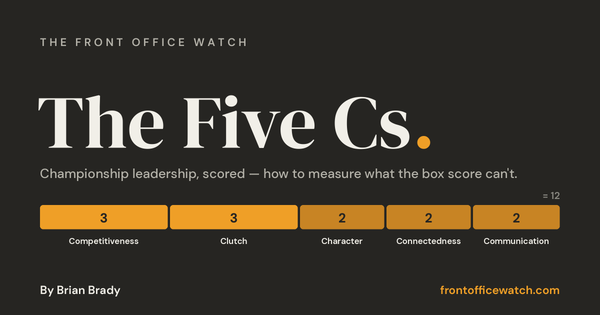
The framework's diagnostic standard is specific. A cornerstone must clear five bars: contracted, available, sufficient prime years, proven as the primary engine of a winning team against elite competition, and established as the organizational leader — the player the team takes its temperature from. The first three are facts. The fourth takes playoff evidence. The fifth takes a rubric — the Five Cs of Championship Leadership — because it's the bar that collapses into vibes without one.
LaMelo is 24 and under contract. He clears the factual bars — on paper. The open questions are the proven ones: has he ever been the primary engine of a winning team against elite competition, and is this team unambiguously his to lead? Those two bars determine whether he is the singular piece around whom a championship organization can be constructed.
LaMelo missed 60 games in 2023-24 with ankle injuries. He played 47 games in 2024-25 before ankle and wrist procedures ended his season. In 2025-26 he appeared in 72 games — the healthiest season of his career — including 56 consecutive appearances to close the year. The Hornets went 44-38 and made the play-in tournament. Brandon Miller emerged as a legitimate second scorer. One healthy season answers the availability question for now. It does not answer the cornerstone question — and that is the one that determines the franchise's direction for the next five years.
Charlotte's front office is behaving as if the answer is yes. The framework says the honest answer is still pending. One healthy season is not confirmation. A playoff series win — against a top-four seed, with LaMelo as the primary offensive engine in a closed series — is the confirmation event the framework is waiting for. If the injury history compounds before that moment arrives, if the defensive limitations prevent this team from ever being genuinely elite, Charlotte will have spent years of Assemble capital on a foundation that needed more time to earn confirmation.
This is the framework forcing a question that outcome-based analysis never asks until it is too late. The LaMelo cornerstone question will be answered by events. The framework's value is demanding that question be asked now — before the capital is spent, before the window is defined, before the reckoning arrives.
What Good Process Looks Like When It Doesn't Work
After trading Kevin Durant to Phoenix in February 2023 and Mikal Bridges to the Knicks in June 2024 for four first-round picks, Sean Marks did something almost no GM in a major market has ever done publicly: he declared the phase.
"When you're able to add that amount of draft assets over the course of the last year, I think that's going to help us in our trajectory long term."
He then spent 18 months refusing to sign veterans to long-term deals despite $60 million in available cap space and persistent public criticism for not spending it. He accumulated five first-round picks in the 2025 draft alone. He made no premature cornerstone commitments. He executed Reset with the discipline the phase demands.
Then he lost the draft lottery at maximum odds in back-to-back years — falling to #8 in 2025 and #6 in 2026, missing franchise-altering top-four selections both times. It is more likely than not, given how lottery odds work, that a team with maximum odds will fall outside the top four. It is also entirely outside a GM's control.
The New York Post ran columns asking why Marks still had his job — based entirely on losing records, with no analysis of whether those records were phase-appropriate. The framework's answer: because losing records and phase-appropriate Reset execution look identical in the standings. The box score can't tell them apart.
A GM who identifies the phase, accumulates the assets, maintains discipline, and loses the lottery deserves a different verdict than a GM who misdiagnoses the phase and spends those picks on the wrong players. The framework can tell them apart. The standings can't.
What This Framework Exists To Do
Most NBA coverage grades outcomes. A GM makes a good trade, the team wins, the GM is considered good. A GM makes a bad trade, the team loses, the GM is fired. The analysis arrives after the evidence is in and attributes the verdict back to a decision made before that evidence existed.
The Front Office Watch grades decisions against the team-building phase the franchise was actually in — not the phase the front office claimed to be in, not the phase the fan base wanted to be in, not the phase that makes the decision look better in hindsight.
A good decision is one that was correct for the actual phase, made with the information available at the time, executed with discipline. A bad decision is one that violated the demands of the team's actual phase — regardless of whether the result was good or bad. The GM who made the right process decision and got unlucky deserves different treatment than the GM who made the wrong process decision and got lucky. The framework is how you tell the difference — before the results arrive, on the record, against a standard that was established in advance.
The verdicts are on the record. The methodology is public. Argue with the framework, not the outcome.
The framework's conclusions are always arguable. Reasonable analysts can disagree on whether LaMelo is a cornerstone, whether the Warriors should be in Reset, whether Marks deserved to keep his job. The framework does not eliminate those arguments. It structures them — gives them a vocabulary, a diagnostic question, and a basis for comparing decisions across different organizations and different eras.
This is what has been missing. Not more reporting. Not faster takes. Not more access to the front offices that creates the incentive to soften the criticism. A framework that asks the right question first — what team-building phase is this franchise actually in — and then grades every decision against the honest answer.
And the most counterintuitive thing that framework reveals: the quality of the player matters less than the phase the team is in when they sign him. Get that wrong and everything else follows.
The Front Office Watch publishes GM profiles, move-by-move analysis, and phase assessments for all 30 NBA teams. The full database is public. Subscribe to the newsletter to follow the framework as it's applied to every front office decision that matters.